
Most AI guides quietly assume you type in English. In Pakistan, that is not how most people think. A student in Multan revising for an exam, a father in Lahore who needs a leave application, a shopkeeper in Karachi writing a Facebook post: their questions come in Urdu first. The good news is that ChatGPT, Claude and Gemini all understand Urdu now. The honest answer to "can AI write good Urdu?" is yes, with a few quirks worth knowing before you trust it with a school application.
This guide is for students, teachers, parents and small business owners. It covers three things: whether to type in Urdu script or Roman Urdu, a real test of all three tools on their free plans with the same five prompts, and twenty-five prompts you can copy and use today.
One shortcut before we start: if typing Urdu is the hard part, write your prompt in simple English and add "answer in Urdu" at the end. In my test, some of the cleanest Urdu came from prompts written exactly that way.
Urdu script or Roman Urdu: which should you type?
Pakistanis type Urdu in two ways: proper Urdu script, the right-to-left Nastaliq of newspapers, and Roman Urdu, the same language in English letters, the way most of us text on WhatsApp: "aap kaise hain, kal class hai?"
All three tools understand both. What changes is the reply. Type in Urdu script and the answer comes back in Urdu script. Type in Roman Urdu and Claude and Gemini usually answer in Roman Urdu too, which is useless if you need text for a letter, a notice board or a school essay. ChatGPT surprised me in the test: I asked in Roman Urdu and it answered in full Urdu script anyway. More on that below.
My advice: for anything you will print, submit or forward to an elder, use Urdu script, or ask for it by name: "jawab Urdu script mein do." For quick questions just for yourself, Roman Urdu is fine and faster.
How to type Urdu script on your phone
On most Android phones the keyboard is Gboard. Tap the globe key or hold the space bar to switch to Urdu. If Urdu is not there, add it in Gboard settings under Languages. From then on, one tap swaps between English and Urdu. iPhones work the same way: Settings, General, Keyboard, Add New Keyboard, Urdu.
If typing still feels slow, use your voice: tap the keyboard microphone and speak Urdu. Spoken Urdu works better than most people expect.
How to type Urdu script on a laptop
On Windows, add Urdu under Settings, Time and language, Language and region; the Windows key plus space bar then switches your keyboard. On a Mac, add Urdu under Input Sources. Too much work? Type in Google Docs with its Urdu input tool and copy the text across.

My test: same 5 prompts, three tools
On November 4, 2026, I ran the same five prompts through ChatGPT, Claude and Gemini, all on free plans, each in a fresh chat: a school leave application, a short translation, a science topic explained simply, an Eid message, and a short poem for children. Two prompts were typed in Urdu script, one in Roman Urdu, and two in English. Here they are, exactly as sent:
Test 1: the leave application
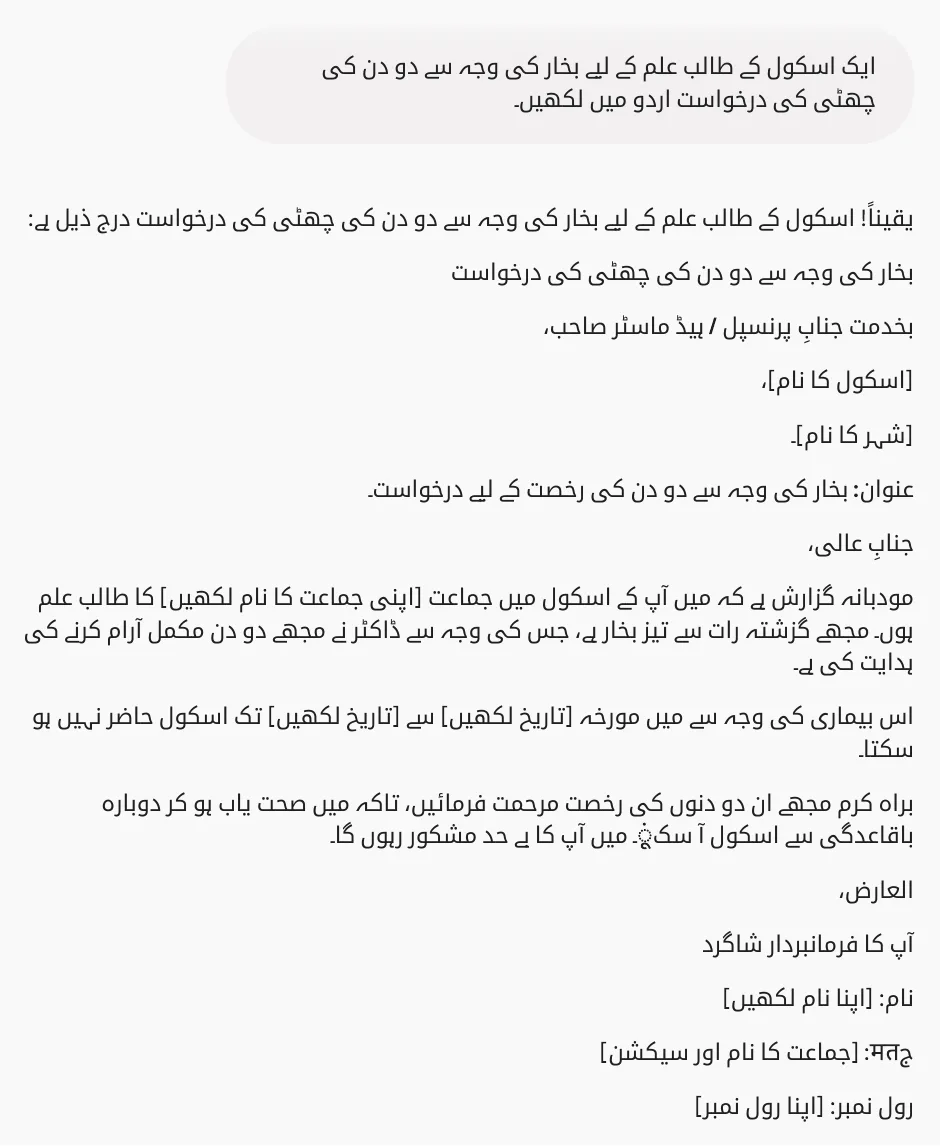
All three wrote a correct application in proper Urdu script, with blanks for name, dates and class. The difference was flavour. ChatGPT's was short and standard, opening with the usual مؤدبانہ گزارش ہے that every school office knows by heart. Claude's added one thoughtful line, promising to complete the missed work after returning: "میں واپس آ کر چھوٹا ہوا کام مکمل کر لوں گا". Any teacher reading that smiles.
Gemini's was correct too, but read like an old government form. It opened with "مودبانہ گزارش ہے" and asked for leave to be granted with "رخصت مرحمت فرمائیں", signing off as an "obedient pupil". A real child does not write like this any more, and a real teacher might find it odd. Here is Gemini's answer as it appeared:
Test 2: the translation
Three nearly identical translations, all correct. The difference was everything around them. ChatGPT gave exactly two sentences and stopped. Claude added a Roman transliteration and a small note explaining that "library" is a borrowed word in Urdu. Gemini added a scholarly Romanization full of accents, the kind nobody in Pakistan actually types. None of the extras are wrong, but if you wanted a translation to paste into a notice, two of the three tools leave you cleaning up after them.
Test 3: explaining photosynthesis, the interesting one
This prompt was typed in Roman Urdu, and here the tools split. ChatGPT answered in full Urdu script anyway. It used the formal textbook word for photosynthesis, ضیائی تالیف, explained the process simply with emojis, and drew a labelled diagram. The diagram took close to a minute, and its labels were in English.
Claude and Gemini both mirrored my Roman Urdu and answered in Roman Urdu. Claude explained a plant as a small kitchen, sunlight as the stove, water and air as raw ingredients: the clearest explanation of the three for a twelve-year-old. Gemini told it as a story, friendly and simple, but wrote the word for roots as "jerein", the sort of spelling slip Roman Urdu invites. Roman Urdu has no standard spelling, and the tools wander just like the rest of us.
The lesson is worth underlining. Claude and Gemini copy the script of your question. If your question is Roman, your answer is Roman, even when you needed script for homework. Add "Urdu script mein" to the prompt and the problem disappears.
Test 4: the Eid message
All three passed easily, warm and correct, well under the limit. ChatGPT's was short and cheerful with emojis. Gemini's was warm too, then added an English translation nobody requested. Claude's had the line I liked most: "آپ کی دعاؤں اور محبتوں کے بغیر ہماری عید ادھوری ہے", "without your prayers and love, our Eid is incomplete". That is a sentence a person would send their mother.
Test 5: the moon poem
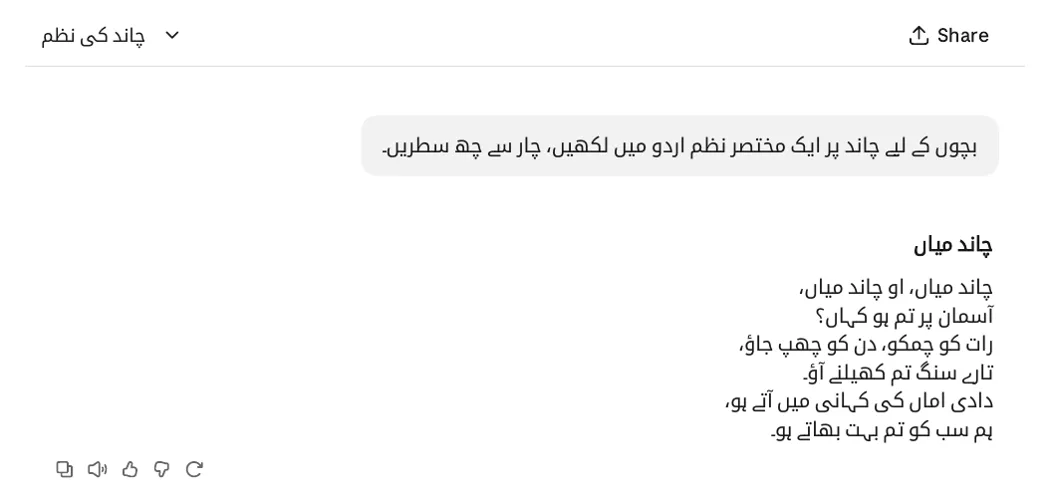
ChatGPT gave six lines about Chaand Mian arriving with the stars, ending with children waving up at him. Gemini gave six gentle lines about moonlit dreams. Claude gave six lines plus a title, and slipped in a grandmother: the moon who shows up in Dadi Amma's stories. A small thing, but it is exactly the reference a Pakistani child grows up with. Here is Claude's poem as it appeared:
The comparison at a glance
| What I checked | ChatGPT | Claude | Gemini |
|---|---|---|---|
| Leave application | Short, standard, ready to use | Complete, with a thoughtful extra line | Correct but very old-fashioned |
| Translation | Translation only, nothing extra | Adds transliteration and a note | Adds a scholarly Romanization |
| Simple explanation | Urdu script, textbook word, drew a diagram | Roman Urdu, clearest kitchen example | Roman Urdu, friendly, one odd spelling |
| Eid message | Short, cheerful, emojis | Warmest line of the three | Warm, plus an unwanted English copy |
| Children's poem | 6 lines, children wave at the moon | 6 lines, Dadi Amma included | 6 gentle lines |
| Script behaviour | Switched my Roman question into Urdu script | Copies the script you type in | Copies the script you type in |
| Speed | Seconds, except the diagram at about a minute | Seconds | Seconds |
So which one is best for Urdu?
For letters and anything formal, ChatGPT and Claude both gave text I could use almost as it stood, and ChatGPT is the most disciplined about giving only what you asked for. For natural, everyday Urdu that sounds like a person from Pakistan wrote it, Claude was my favourite in this test. Gemini is generous and quick, and answered these five prompts without even asking me to sign in, but budget a minute to delete its extras and soften its formal letters. Practical answer: keep two of them. If the tone feels off in one, paste the same prompt into the other. It costs nothing but a minute.
A small confession: I could not screenshot every answer cleanly, because one tool's printable view hid its own replies. The two screenshots above are real screens from the test, and the quotes are copied word for word.
20 Urdu prompts you can copy
Square brackets mean replace that part with your own detail. Where a prompt is in English, that is deliberate: English instructions with "in Urdu" at the end gave the most reliable results in the test.
Letters and applications
1. Leave application for an office
Naming the dates and tone up front makes the answer ready to sign.
2. Complaint about a wrong electricity bill
Polite and firm is hard to manage when you are annoyed. Let the tool do it.
3. School admission application
Good for the first admission season panic. Fill the brackets and print.
4. Job application
Spaces for phone and address stop the tool inventing fake ones, which it will happily do.
Translation
5. English notice into simple Urdu
The words "simple" and "everyday" do the real work in this prompt.
6. Urdu letter into formal English
"Nothing except the translation" is in there because of what Gemini did in my test.
7. Explain a document for an elder
For bank letters, hospital papers and official notices written to confuse.
8. Formal and informal versions
Urdu runs on respect levels. One message rarely fits both a grandfather and a friend.
Studying
9. Explain a topic simply
The two test questions turn reading into revision.
10. Urdu essay outline
An outline gives the essay a spine.
11. MCQs in Urdu
Answers at the end, or you will peek. Everyone does.
12. Explain a poem
That order matches how teachers mark it.
Nursing students: my guide to AI prompts for nursing students has a Prompt 34, "Explain in Urdu", that turns a condition or care instruction into simple Urdu a patient can follow, with the English beside it. If you practise in Pakistan, it may be the most useful prompt on this site.
Daily life
13. Occasion message for WhatsApp
"Just the message" keeps it copy-paste ready.
14. Wedding invitation message
Short matters. Nobody reads a long invitation to the end.
15. A recipe in Urdu
Cups and spoons, because most home kitchens in Pakistan do not own a scale.
16. Doctor's instructions, explained simply
That last sentence matters. Explanation yes, new advice no. The safety section below says more.
Work
17. Shop post for Facebook
The blank for the WhatsApp number stops an invented number going out to your customers.

18. Price list for WhatsApp
A tidy list looks professional. A photo of a notebook page does not.
19. Reply to an unhappy customer
Writing this reply while angry is how customers are lost. Let the tool cool it down.
20. Caption for a product photo
Two sentences is plenty for a caption.
For Pakistanis abroad: 5 bonus prompts
Not every Urdu speaker lives in Pakistan. If you are raising a family in the US, UK or Canada, Urdu often becomes the bridge between your children, your parents and home. These five prompts are for that life.
21. A school notice, explained for your parents
American school notices are full of words that need explaining, not just translating.
22. Doctor or pharmacy instructions for an elder
The same safety rule as Prompt 16 applies. The AI explains, and the doctor's instructions stay exactly as written.
23. A small Urdu lesson for your child
Ten words a week, on topics your child cares about, add up faster than a textbook.
24. A message to family back home
When you can't be there, the message has to carry the respect your visit would have.
25. One invitation, two audiences
Two languages, one message, and nobody feels like an afterthought.
Common problems and how to fix them
The Urdu is too formal and bookish. You saw this in Gemini's leave application. Add this line: "Write as people speak in Pakistan, simple everyday Urdu." The next answer will sound like a person.
It answers in Roman Urdu when you need script. Claude and Gemini copy your script, so a Roman question earns a Roman answer. Add "jawab Urdu script mein do", or in English, "answer in Urdu script". One line fixes it.
English words keep sneaking in. Some are normal: library, school and meter are Urdu now too. For the rest, add "use pure Urdu words where they exist". Science terms often stay English in Roman Urdu answers; even Claude's kitchen explanation kept Chlorophyll and Glucose in English.
It adds extras you never asked for. Transliterations, English translations, little lectures. Add "sirf yehi do, is ke ilawa kuch nahi" ("only this, nothing else"). ChatGPT needed this least in my test.
Odd spellings appear. Roman Urdu has no fixed spelling, so tools improvise, like Gemini's "jerein" for roots. For anything important, prefer Urdu script, where spelling is settled. If a word looks wrong, run the same prompt in a second tool and compare.
The facts are wrong. Urdu answers can be as confidently wrong as English ones. Dates, names, prices, marks, medical facts: check them the way you would check a rumour. The AI drafts, you decide.
Safety and honesty
Two rules cover most of the risk. First, never type your CNIC number, bank details, passwords or one-time codes into any AI chat, in any language. A letter that needs your CNIC can carry a blank for it, like the prompts above. Fill the number in by hand afterwards, never in the chat.
Second, be extra careful with religious and medical content. AI Urdu sounds fluent and certain, and fluency is not correctness. A Quranic translation, a ruling about fasting, a medicine dosage: check these with a reliable printed source, a scholar or your doctor first. Use the AI to understand the question, not to settle it.
Frequently asked questions
Which AI is best for Urdu?
In my five-prompt test, Claude wrote the most natural everyday Urdu, ChatGPT was the most disciplined and gave clean script even when asked in Roman Urdu, and Gemini was quick but added extras and wrote formal letters in an old-fashioned style. Start with ChatGPT or Claude and keep the other as a backup.
Is ChatGPT free in Urdu?
Yes. ChatGPT's free plan handles Urdu script and Roman Urdu, and everything in this guide ran on free plans of all three tools. Free plans have daily limits, but ordinary letters, messages and explanations are fine.
Can AI write Urdu poetry?
Yes, simple rhyming poetry surprisingly well. All three tools wrote short moon poems for children that scanned and rhymed, and Claude even worked in a grandmother's stories. Do not expect Iqbal, but for a school function or a child's birthday, what they write is genuinely usable.
Can I talk to AI in Urdu by voice?
Yes. All three apps accept voice input, and the keyboard microphone on your phone also understands spoken Urdu well. Voice is the fastest route for parents and elders who find typing slow, and you can still ask for the written answer in Urdu script.
Is AI translation reliable for official documents?
For understanding a document and for drafts, yes. For anything legal, a birth certificate, a court paper, a property document, use the AI version only as a draft and get a certified translator to confirm it. One wrong word can cost months.
Why does it answer in Roman Urdu when I want script?
Because Claude and Gemini mirror the script of your question. Type in Roman Urdu and they answer in Roman Urdu. Add "answer in Urdu script" to your prompt, or ask the question in English, and you will get proper script back.
Do these prompts work outside Pakistan?
Yes. ChatGPT, Claude and Gemini handle Urdu the same way in the US, UK or anywhere else, and their free plans work there too. Only the examples change: swap Pakistani details, like CNIC or the electricity company, for your own.
Final thoughts
Not long ago, "just ask the AI" quietly assumed you could ask in English. For Urdu speakers, that is changing fast. The tools write Urdu well enough for applications, notices, essays, messages and shop posts, and the remaining problems are fixable with one extra line in your prompt. Start with the leave application or the Eid message. One good Urdu answer, seen with your own eyes, teaches more than this whole page.
To practise, try this site's own free AI chatbot, linked from the homepage. Then keep going with 40 AI prompts for students, the nursing students collection and how to write better AI prompts. Choosing just one tool? The comparisons go deeper: ChatGPT vs Claude, ChatGPT vs Gemini and Claude vs Gemini.