
Last month, my cousin — he's in 10th grade — called me in a mild panic. Physics test in three days, and half the chapter made no sense to him. "I tried asking ChatGPT," he said, "but it just gave me answers I didn't understand. So now I have answers and confusion."
That sentence stuck with me, because it captures exactly how most students use AI: as an answer machine. And answer machines don't teach you anything. The students who actually get smarter with AI use it as a tutor — one that's patient, free, and awake at 2 AM before an exam.
The difference between those two experiences isn't the tool. It's the prompt.
So I put together 40 prompts I wish someone had handed me in school. They're organized around the six things students actually need: understanding hard topics, preparing for exams, writing essays, solving math, doing research, and staying organized. Every one is copy-paste ready — just replace the parts in [brackets] and run it on any free AI plan.
How to Get Good Results (Read This First)
Three quick habits that make every prompt below work twice as well:
- Replace every [bracket]. The brackets are where your situation goes in. A prompt with your real topic, grade, and deadline beats a generic one every time.
- Follow up. If the first answer is close but not quite right, say so: "Simpler." "Give me an example." "Now quiz me on this." The first answer is a starting point, not a final verdict.
- Verify anything factual. AI sometimes invents dates, formulas, and quotes with total confidence. For anything you're submitting or being tested on, cross-check with your textbook.
If you want the full method behind good prompting, read my beginner's guide to writing better AI prompts — these 40 are that method, pre-built for student life.
The One Rule: Use AI to Learn, Not to Cheat
Let's be honest for a minute, because this matters. There's a line, and you know where it is:
- Learning: "Explain this concept until I get it, then quiz me." You walk into the exam understanding the material.
- Cheating: "Write my essay so I can submit it." You walk into the exam understanding nothing — and teachers can increasingly tell.
Here's the practical truth nobody tells students: the "cheating" prompts feel efficient but they're a trap. The exam, the next class, the job interview — they all test what you know, not what your AI knew at 11 PM. Every prompt in this article is designed for the learning side of the line. Use them that way and AI becomes the best tutor you've ever had — one that never gets tired of your "wait, explain that again."
1. Understanding Difficult Topics
For the chapters that make no sense no matter how many times you re-read them. These prompts turn AI into the patient tutor who explains things five different ways until one clicks.
Prompt 1: The Simple Explainer
Why it works: The grade level sets the vocabulary; the analogy gives your brain something to hold onto.
Prompt 2: The Analogy Machine
Why it works: If one analogy doesn't click, the next one might. Three chances instead of one.
Prompt 3: The Stuck-Point Zoom
Why it works: Naming the exact stuck point stops AI from re-explaining the parts you already know.
Prompt 4: Key Terms Decoder
Why it works: Half of "not getting it" is vocabulary. Learn the words, and the chapter opens up.
Prompt 5: The Connection Finder
Why it works: Exams love connections between topics. This prompt thinks the way examiners think.
Prompt 6: The Myth Buster
Why it works: Wrong ideas you're carrying feel identical to right ones. This prompt hunts them down.
Prompt 7: The Draw-It-Yourself Guide
Why it works: Turning words into a drawing forces real understanding — and diagrams are exam gold.
2. Studying & Exam Prep
For turning panic into a plan. These prompts build your study schedule, test you like an examiner, and squeeze your notes into something you can actually revise.
Prompt 8: The Study Plan
Why it works: It does the planning math you'd avoid doing yourself — and "hardest first" is how top students actually study.
Prompt 9: The Quiz Maker
Why it works: Testing yourself beats re-reading notes every single time. This is backed by actual learning science, not just my opinion.
Prompt 10: The Answer Checker
Best for: Right after Prompt 9. Attempt first, then get graded — that's the loop that builds memory.
Prompt 11: Flashcards From Notes
Why it works: You get revision-ready flashcards in seconds instead of spending an hour making them by hand.
Prompt 12: The One-Page Cheat Sheet
Why it works: The night before an exam, you need one page — not forty. Constraints force the important stuff to survive.
Prompt 13: The Strict Examiner
Why it works: "One at a time" plus "wait for my answer" turns a chatbot into an oral exam. Uncomfortable — and extremely effective.
Prompt 14: The Memory Hook
Why it works: Your brain remembers stories and silly images far better than plain lists. Use that.
3. Writing & Essays
For essays, reports, and assignments — used the right way. These prompts help you plan, draft, and polish your own writing. They make you a better writer; they don't replace you as one.
Prompt 15: The Outline Builder
Why it works: The outline is 80% of essay writing. This gives you the skeleton; you add the thinking.
Prompt 16: The Thesis Sharpener
Why it works: Weak thesis, weak essay. Three options let you pick instead of staring at a blank page.
Prompt 17: The Opening Helper
Why it works: Starting is the hardest part. Borrow a first sentence, then take over.
Prompt 18: The Paragraph Fixer
Why it works: The "what you changed and why" part is the real lesson — you learn editing by watching it done.
Prompt 19: The Vocabulary Upgrade
Why it works: Builds your word bank without a thesaurus rabbit hole.
Prompt 20: The Citation Formatter
Why it works: Citations are pure formatting pain with zero learning value. Automate the pain.
Prompt 21: The Conclusion Options
Why it works: Conclusions that introduce new points lose marks. This constraint keeps yours clean.
4. Math & Problem Solving
For the subject where "just give me the answer" helps least. These prompts force the method into your head — because the exam will change the numbers.
Prompt 22: The Step-by-Step Solver
Why it works: "Why" is what transfers to new problems. "What" only solves this one.
Prompt 23: The Concept Check
Why it works: Half of math exams is recognizing which tool a problem wants. This trains exactly that.
Prompt 24: The Mistake Finder
Why it works: Finding your own error teaches more than ten correct examples. This prompt plays teacher.
Prompt 25: Practice Problems, Easy to Hard
Why it works: Endless practice material on any topic, at your level, in seconds.
Prompt 26: The Formula Explainer
Why it works: Formulas you understand beat formulas you memorize — especially under exam pressure.
Prompt 27: The Word Problem Decoder
Why it works: Word problems are translation problems. This prompt separates "translate" from "solve."
Prompt 28: The Alternative Method
Why it works: Top students don't just know one method — they know the fastest one.
5. Research & Projects
For assignments, presentations, and group projects. These prompts organize your research and your slides — the content and thinking stay yours.
Prompt 29: The Research Starter
Why it works: "Research [topic]" is overwhelming. Five sub-questions make it a checklist.
Prompt 30: The Source Evaluator
Why it works: Not everything on the internet deserves your bibliography. This prompt teaches source judgment.
Warning: AI sometimes invents sources that don't exist — real-looking titles, authors, even links. Always find and open every source yourself before citing it.
Prompt 31: The Presentation Outline
Why it works: Most student presentations are lists of facts. Hook plus closing line makes yours memorable.
Prompt 32: The Slide Helper
Why it works: Fixes the #1 student presentation sin: reading paragraphs off slides.
Prompt 33: The Group Project Splitter
Why it works: Ends the "so... what is everyone doing?" chaos in one message you can paste to the group chat.
Prompt 34: The Interview-First Helper
Why it works: This outsources the "what should I have told you?" problem to the AI itself. Three sharp questions up front save you from three rounds of "no, that's not what I meant."
6. Planning & Productivity
For the part of student life nobody teaches: managing time, beating procrastination, and actually sticking to plans.
Prompt 35: The Homework Triage
Why it works: Decision fatigue is real. This prompt makes the plan so you can just execute.
Prompt 36: The Realistic Morning Routine
Why it works: "Not perfect" is the magic constraint — perfect routines die by Wednesday.
Prompt 37: The Procrastination Breaker
Why it works: You don't need motivation; you need a first step so small it feels silly to refuse.
Prompt 38: The Weekly Review
Why it works: Ten minutes of honest review beats ten hours of blind repetition.
Prompt 39: The Goal Setter
Why it works: "Study harder" isn't a plan. Checkpoints turn wishes into systems.
Prompt 40: The Explain-It-Back Test
Why it works: If you can teach it, you know it. This is the final boss of every topic — and the best exam predictor there is.
My Own Tests: 2 Prompt Pairs, With Screenshots
You don't have to take my word for any of this. I ran these two pairs myself on a free AI chat — same tool, minutes apart, weak prompt first and fixed prompt second. Here's what actually happened.
Test 1: Explaining photosynthesis (Prompt 1)
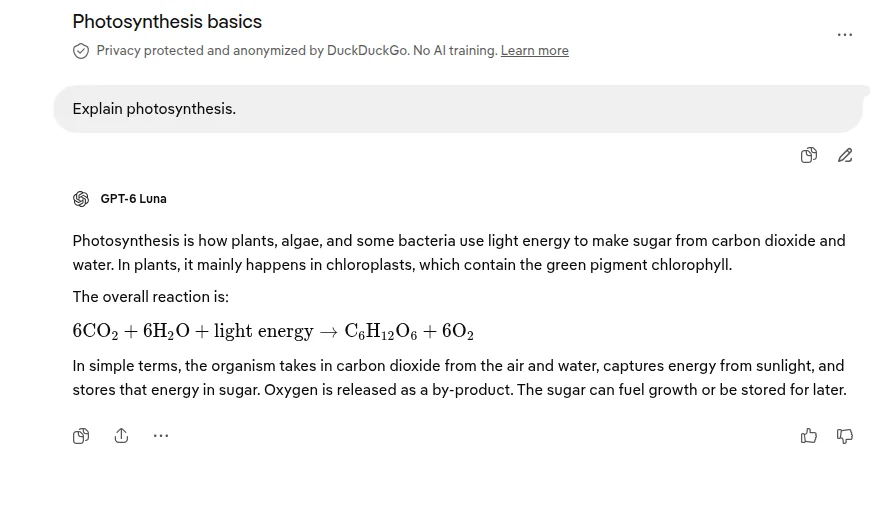
Weak prompt:
What came back was a formal mini-lecture: definitions, the chemical equation, bullet points. Every word correct — and written like a textbook chapter, not for a confused student.
Fixed prompt:
What came back was short, friendly, and built around a single analogy — a leaf as a "tiny solar-powered kitchen," with sunlight as the electricity and sugar as the meal. Same facts, completely different readability.
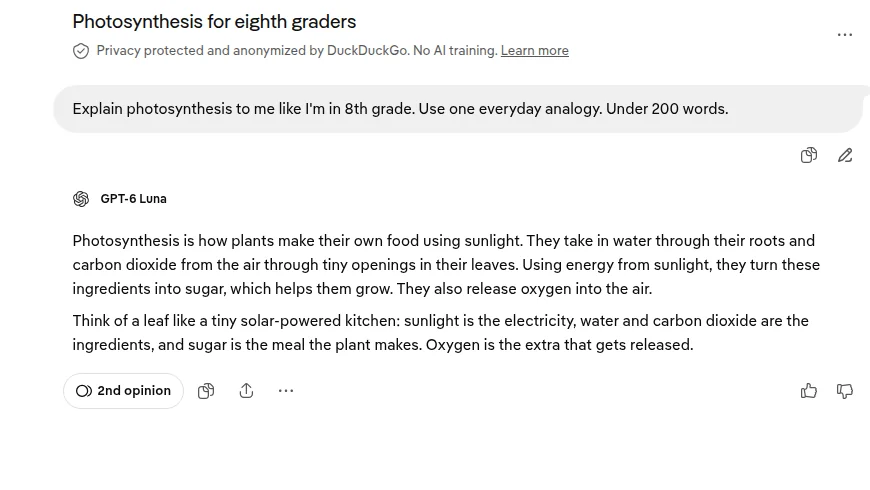
What changed: a grade level, one analogy, and a word limit turned a lecture into an explanation.
Test 2: Making a quiz (Prompt 9)
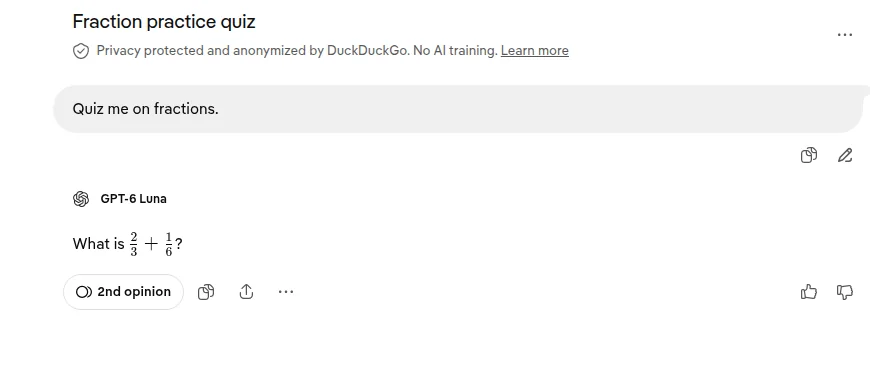
Weak prompt:
What came back was... a single question. "What is 2/3 + 1/6?" That was the entire quiz. The AI had no idea what a quiz meant to me.
Fixed prompt:
What came back was a properly structured 10-question quiz — multiple choice first, answers withheld exactly as asked. Ready to attempt, then get graded with Prompt 10.
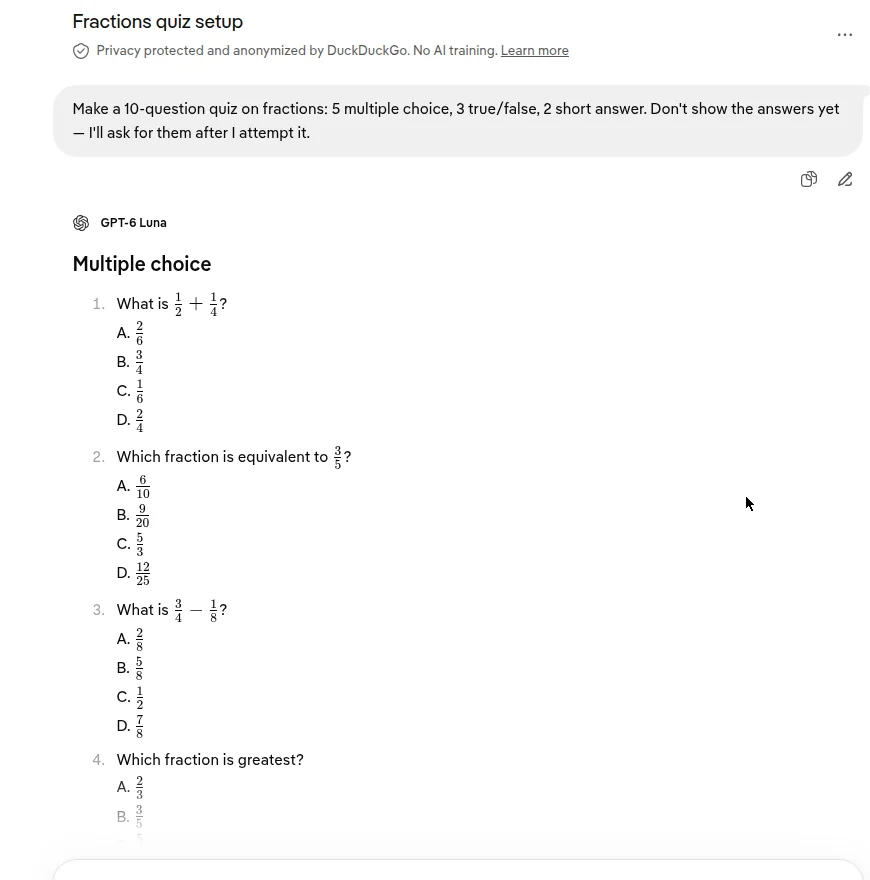
What changed: a number, a structure, and one instruction ("don't show answers yet") turned one question into a study session.
Tested October 2026 on Duck.ai's free chat (GPT-6 Luna model, no login needed). Your results will vary a little by model — but the pattern holds everywhere: specific prompts get specific answers.
Which Free AI Should Students Use?
Short answer: any of the big three free plans will run all 40 prompts. Longer answer: they have different strengths — ChatGPT is the all-rounder, Claude is excellent at writing and long documents, Gemini is handy if you live in Google Docs and Classroom. Check each tool's age requirements before signing up. I compared them properly here:
- ChatGPT vs Claude Free Plan (2026) — which free assistant fits your kind of work
- ChatGPT vs Gemini Free Plan (2026) — how Google's free AI compares
- Claude vs Gemini Free Plan (2026) — writing strength vs Google ecosystem
- How to Write Better AI Prompts (2026) — the method behind every prompt in this article
- 25 AI Prompts for Teachers (2026) — share this one with your favorite teacher
Frequently asked questions
Will my teacher know I used AI?
For learning prompts like these, it doesn't matter — the understanding is yours, and that's what gets tested. For submitted work, many schools now use AI detectors and have policies about it. When in doubt, ask your teacher what's allowed. "I used AI to understand the topic, then wrote it myself" is something most teachers respect.
Is using AI for homework cheating?
It depends on how you use it. Getting AI to explain a concept so you can do the homework yourself: learning. Pasting the assignment in and submitting the output: cheating — and it catches up with you at exam time. The prompts in this article are built for the first kind.
Which free AI is best for studying?
All three major free plans (ChatGPT, Claude, Gemini) handle these prompts well. If you work with long documents or lots of writing, Claude's free plan is strong; for all-round use with image generation, ChatGPT's free plan is the safe default. My full comparison is linked above.
What if the AI gives me a wrong answer?
It happens — confidently wrong answers are AI's most famous flaw. For anything you'll be tested on or submit, verify formulas, dates, and definitions against your textbook or class notes. Treat AI as a brilliant tutor who occasionally needs fact-checking.
Can these prompts help with learning English (or another language)?
Yes — adapt them. "Explain [grammar rule] with 5 examples," "Correct my paragraph and explain each correction," and "Quiz me on 10 vocabulary words, one at a time" all work beautifully for language learning.
Studying in Urdu? Our guide to ChatGPT, Claude and Gemini in Urdu tests 25 prompts in Urdu script and Roman Urdu.