
The last hour of the shift
Picture the last hour of a day shift on a busy ward. It is 6:40 p.m. Handover starts in twenty minutes. One discharge is still waiting on pharmacy. A daughter has come back to the nurses' station for the third time, kind, worried, and full of questions nobody has answered. And the notes, as always, are not done.
Nothing in that hour is dramatic. Every item on the list is small. Together they are the reason so many nurses chart from memory at 8 p.m., or replay a difficult conversation at midnight.
Every nurse owns a version of that hour: the discharge summary, the family meeting and the evening medications landing at once, pharmacy on the phone promising the discharge medicines in "two more minutes" for the third time, and the only thing finished on time is the worrying.
Let us be honest about what AI can and cannot do here. It cannot lift a patient, start a line, read a room, or sit with a family while the news lands. What AI can do is take the paperwork and the word-finding off your plate: a draft of a teaching sheet, the shape of an incident report, the opening line of a conversation you are dreading.
This guide is for staff nurses in med-surg, ICU, ER, clinic and home health, and for new graduates in their first year. These prompts are written to work in any major free AI tool. One of them, the discharge prompt, was tested in two tools and checked line by line; the results are in the test section below.
Before anything else: the rules that keep your license safe
Four rules, and they come before every prompt in this guide. They are the difference between AI as a drafting tool and AI as a career problem.
- No real patient details, ever. No names, no record numbers, no dates of birth, no room numbers, no photos. In the US that is HIPAA. Everywhere else it is basic professional ethics. Every prompt in this guide works with invented or de-identified details.
- Check your hospital's AI policy first. Many hospitals block free AI tools on work computers, and some ban them on shift entirely. When the policy says home use only, use these at home, on your own device.
- AI never makes the clinical call. It does not decide, it does not calculate a dose, and it does not replace a protocol. Your unit's protocol and your own judgment win every argument, even when the AI sounds sure of itself.
- Use the manager test. Before you press send on any prompt, ask: would I be comfortable if my nurse manager read this chat? If the answer needs a pause, rewrite the prompt.
One more thing: this guide is about using AI tools for the writing around nursing. Nothing here is medical advice, and none of it outranks your training, your protocols or your charge nurse.
Before your shift (prompts 1 to 5)
Ten quiet minutes can replace the scramble of looking things up mid-round. Use these at home or in the break room before you take report.
Prompt 1: refresh a condition you have not seen in a while
Why it works: it asks for watch-fors and handover questions, not a lecture, so the answer arrives in shift order.
Prompt 2: a rarely used procedure, refreshed
Why it works: the last line keeps the AI honest about local variation, and it reminds you to check the protocol while you still have time.
Prompt 3: your personal SBAR template
Why it works: the weak and strong pair teaches more than any definition of SBAR. Save the template; it is yours for the year.
Prompt 4: a time plan for a heavy load
Why it works: the final question is the real prize. Knowing in advance what can move is what keeps the plan useful past 9 a.m.
Prompt 5: floated to an unfamiliar unit
Why it works: this prompt writes the questions down while you still have the nerve to ask them.
Patient teaching people actually understand (prompts 6 to 11)
Teaching fails in two ways: words the patient cannot follow, and sheets so long that nobody reads past the first page. These prompts attack both problems. Keep the reading level in the prompt itself, and read every draft before it reaches a patient.

Prompt 6: discharge instructions at a 6th-grade reading level
Why it works: this exact prompt was run in ChatGPT and Gemini for the test in this guide, and both tools kept the language simple. The fluid limit is another story, told in full in the test section below.
Prompt 7: teach-back questions for any topic
Why it works: teach-back checks understanding, and the forgetting question matters most, because home is where the forgetting happens.
Prompt 8: the same instructions in Spanish, checked by a human
Why it works: the marking request turns the AI into a first drafter that flags its own weak spots, which a human interpreter can check fastest.
Prompt 9: a new diagnosis, without the jargon
Why it works: the "what stays the same" line does quiet, heavy work. New diagnoses frighten people partly because everything sounds changed.
Prompt 10: a one-page sheet for a caregiver
Why it works: caregivers do much of the real aftercare, and they usually get the leftover explanation at the door. A numbered sheet respects their time and their role.
Prompt 11: a new insulin or inhaler routine, step by step
Why it works: routines fail at the same two or three steps for every patient, and the "when it goes wrong" lines cover exactly those steps.
Watch it happen once and you never forget it. A patient nods through fluent, careful instructions about fluid and salt, then goes home and drinks the soup his family has always made, because nobody translated the rules into his kitchen. The words were correct. They were simply never his.
The conversations nobody trained you for (prompts 12 to 16)
Nursing school taught you assessments and medications. Nobody ran a class on the angry son at the desk, the 3 a.m. call, or the colleague you have to refuse. Rehearsing the words in advance is not fake: actors rehearse, surgeons rehearse, and nurses are allowed to rehearse too.
Prompt 12: an angry family member at the nurses' station
Why it works: opening lines are the hardest part. The never-say list is worth saving on its own.
Prompt 13: when a family wants "everything done"
Why it works: "what never changes" is the sentence families hold on to, and the prompt asks for it by name.
Prompt 14: a clear SBAR call at 3 a.m.
Why it works: at 3 a.m. nobody needs your whole shift story. A request-first call gets a decision faster.
Prompt 15: saying no to a colleague, without the feud
Why it works: an unsafe yes helps nobody, and an unplanned no comes out sharper than you meant it. Two scripts, because this conversation happens in two very different rooms.
Prompt 16: feedback to a new nurse you are precepting
Why it works: new nurses remember feedback word for word. Two rehearsed minutes can shape a whole first year.
Paperwork, minus the panic (prompts 17 to 21)
The paperwork prompts all share one rule: AI builds the shape, you write the substance. Structure with invented details, content from your own eyes, in the official system.
Prompt 17: a structure for documentation notes
Why it works: a blank page at the end of a 12-hour shift is where details get lost. An outline turns charting into filling gaps, which is faster and safer.
Prompt 18: a new hospital policy in 5 points
Why it works: policies are written for auditors and read by nobody. Five plain points are what a policy looks like after a nurse has translated it.
Prompt 19: an incident report written as facts
Why it works: seeing the gaps while the shift is still fresh is worth more than the draft itself.
Prompt 20: an email to your manager about staffing
Why it works: staffing emails written at midnight rarely read well at 9 a.m. A short structure keeps the problem visible and the temperature down.
Prompt 21: a checklist for a unit task
Why it works: the stop-and-ask box gives the newest nurse on the unit a written permission slip to pause.
Growing your career (prompts 22 to 26)
Nursing careers grow in the margins: a certification studied for in 45-minute pieces, a resume that says what you do, an interview you rehearsed. AI is a patient study partner, as long as you refuse to let it invent your achievements.
Prompt 22: a study plan for a certification exam
Why it works: the plan is built around a nurse's hours instead of a student's, and a plan that survives night shifts gets finished.
Prompt 23: a resume built from your own experience
Why it works: that final instruction matters. AI resume help goes wrong exactly where it starts rounding your career up.
Prompt 24: interview practice, one hard question at a time
Why it works: interviews reward stories told well, and most nurses have the stories. They have simply never said them out loud before the day.
Prompt 25: choosing between two job offers
Why it works: offers are easy to compare on pay and hard to compare on everything that decides your Tuesdays.
Prompt 26: a short case presentation for an in-service
Why it works: the honest pair at the end, one strength and one change, is what makes colleagues listen.
After the shift (prompts 27 to 30)
The last four prompts are for the nurse, not the job. Recovery is part of the work.
Prompt 27: a wind-down routine after night shift
Why it works: naming your real constraints in the prompt is what makes the routine survivable for a tired person.
Prompt 28: sleep when you switch between days and nights
Why it works: rotating shifts punish random sleep, and a written plan for the switch days protects the shifts on either side.
Prompt 29: meal prep for 12-hour shifts
Why it works: the break room rule is small and real, and food you can actually eat beats a perfect plan.
Prompt 30: a 10-minute reflection after a hard shift
Why it works: the last instruction is there on purpose, and it leads to the most important line in this section.
AI is not therapy. If burnout is getting heavy, talk to a person: your employee assistance program, a colleague you trust, or a professional. A chatbot can hold a list. It cannot hold you.
My test: one discharge sheet, two tools
Prompt 6, exactly as printed above, was run once each in ChatGPT and Gemini on free plans. The patient is fictional. Both sheets were then checked three ways: the reading level, clinical accuracy against what a heart failure discharge should say, and anything the tool added unasked. This test compares ChatGPT and Gemini.
ChatGPT: careful, complete, and long
ChatGPT produced the more cautious sheet. On fluids, the one number that belongs to the patient's own care team, it refused to settle the question itself: follow the limit your care team gave you, it said, noting the limit may be about 6 to 8 cups a day and that the patient's own may differ. It left a printed blank, "My daily fluid limit: ______ cups per day," and it added a note to the care team, asking them to confirm the exact limit, the dose and the call instructions before the sheet reaches a patient. Nobody asked for that note. It is the most professional paragraph in either answer.
Two more quiet strengths: a warning against salt substitutes unless the care team approves them (many are potassium based, a real risk), and a clear line against taking extra water pills when weight rises, the most tempting piece of self-treatment at home. The weaknesses are size and one thin answer. At about 660 words, with a follow-up section nobody requested, the sheet is a lot to hand a tired patient. And on a missed dose it only says to ask the care team. Safe, certainly; helpful at 9 p.m. on a Sunday, less so.
Gemini: tidy, short, and one number too sure
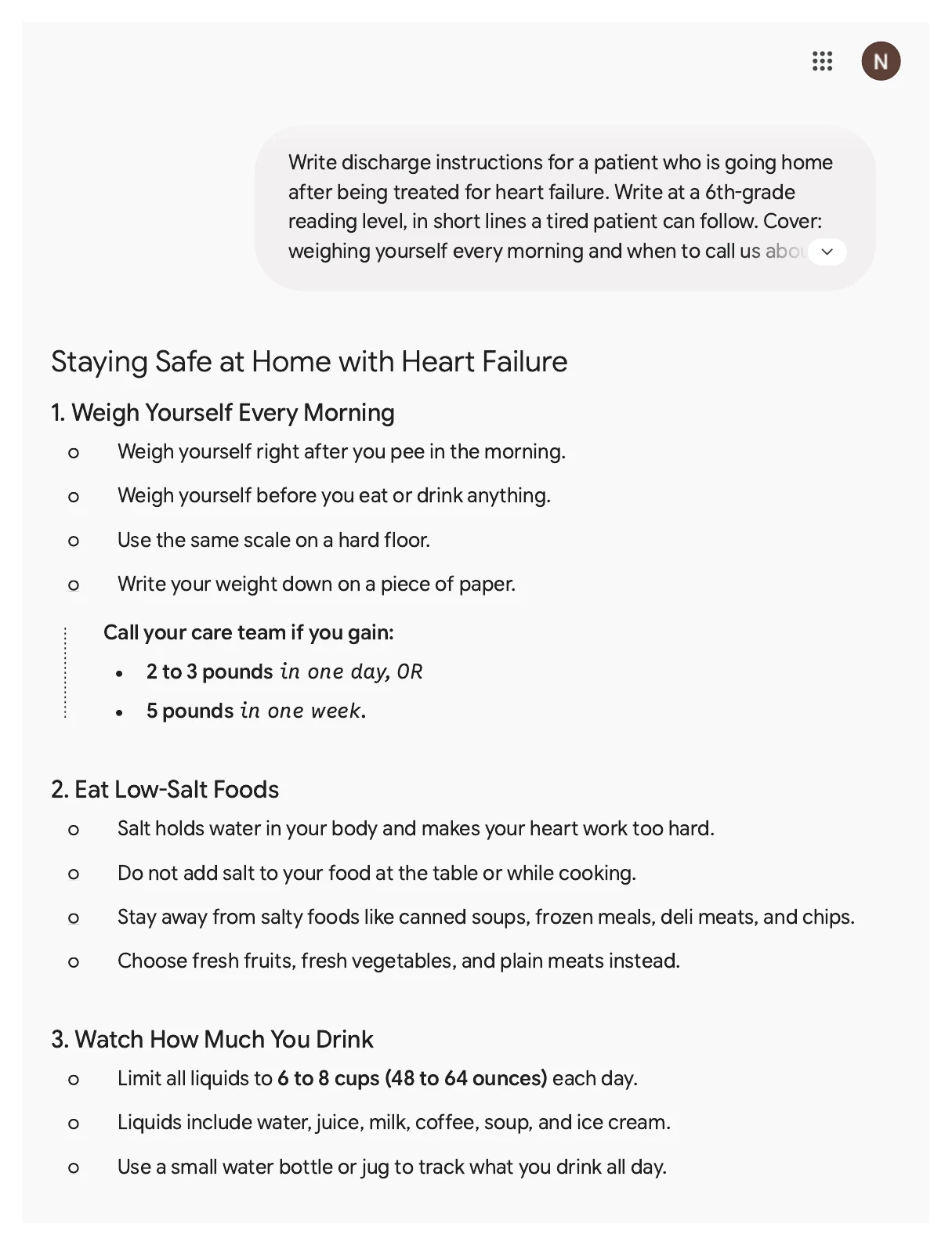
Gemini's sheet is tidier: about 340 words, clean sections, a proper fridge line. Its weight warning matches the common teaching, call for a gain of 2 to 3 pounds in a day or 5 pounds in a week (American Heart Association warning-signs guidance; see American Association of Heart Failure Nurses, Daily Weights), and its warning signs are split clearly, even adding a symptom the other sheet lacked: coughing up pink or frothy mucus. If the test stopped at tidiness, Gemini would win it.
It does not stop there, because of one sentence: "Limit all liquids to 6 to 8 cups (48 to 64 ounces) each day." The prompt gave no fluid number, and no patient's team set one. The range sits inside common practice, which is exactly what makes it dangerous in print. A nurse reading quickly could hand this sheet over as it stands, and a made-up limit would walk out of the hospital dressed as an order. The same habit shows in the walking section, which invents a time of 5 to 10 minutes that nobody prescribed. And for all its tidiness, the sheet never mentions a missed dose at all, and skips the salt substitute warning entirely.
Quotes here come from the version saved in the chat.
Reading level: both passed easily
On the Flesch-Kincaid check, ChatGPT's sheet scored about grade 2.5 and Gemini's about grade 3, both far below the grade 6 target in the prompt. Short lines and plain words did the work: reading level is the least of a nurse's worries. The numbers a tool invents are the worry.
| Check | ChatGPT | Gemini |
|---|---|---|
| Reading level (Flesch-Kincaid) | About grade 2.5 | About grade 3 |
| Length | About 660 words, runs past one page | About 340 words, fits one page |
| Weight warning | Call at 2 pounds in a day, 5 in a week | Call at 2 to 3 pounds in a day, 5 in a week (American Heart Association warning-signs guidance; see American Association of Heart Failure Nurses, Daily Weights) |
| Fluid limit | Defers to the care team's own limit, leaves a blank, adds a note to the team | States 6 to 8 cups a day as a flat instruction nobody set |
| Salt substitutes | Warns against them without team approval | Not mentioned |
| Missed dose | Says ask the care team (safe, thin) | Not mentioned at all |
| Unasked extras | A follow-up visits section, and the note to the care team | None |
| Fridge line | Yes, as a closing summary | Yes, labelled "Fridge Note" |
The verdict on the evidence: the sheet to hand a patient, after a nurse fills in the fluid blank, is ChatGPT's. Gemini's is the better skeleton once its fluid sentence carries the team's real limit. And to be fair to Gemini, both tools named the same range, about 6 to 8 cups a day. Only Gemini wrote it as an order. ChatGPT offered it as a rough guide and left the real number to the care team.
My own verdict, after reading both sheets the way a tired patient would read them: ChatGPT's is the only one I would let leave the printer, and even that one needs its fluid blank filled in first, in a nurse's handwriting.
What AI gets wrong in real nursing work
Confident numbers nobody gave it. The Gemini fluid limit is the pattern to learn. These tools would rather invent a plausible number than leave a gap, and plausible numbers can do real harm. Any figure in an AI draft that you did not supply needs checking before use.
Teaching sheets that run long. ChatGPT's answer added a whole section and ran close to twice the length of the other sheet. Length is a clinical problem in teaching, because patients stop reading. Add a line about length to the prompt, and cut without mercy.
Translations that read smoothly and still miss. A translated sentence can be grammatically fine and culturally wrong. Prompt 8 makes the tool flag its own uncertain lines: a qualified interpreter checks anything that reaches a patient, and AI translation never touches a consent form.
Generic advice that has never seen your unit. Left alone, AI writes for an average ward that does not exist. Put your unit type, your patient mix and your real constraints into the prompt, and the help stops being generic.
Guidelines with an expiry date. These tools learned from material of mixed ages, and practice changes. Check drug facts and thresholds in any draft against current sources.
Questions nurses ask about AI at work
Is it legal for nurses to use ChatGPT at work?
The law is rarely the problem; your employer's policy and patient privacy are. Using a free AI tool with invented or fully de-identified details is a different thing from pasting anything about a real patient into a consumer chatbot, which can break HIPAA in the US and professional codes anywhere. Many hospitals block free tools on work systems entirely. Read your hospital's AI policy first, and when there is no policy, use the rules in this guide and keep real patients out of the chat completely.
Can AI write my nursing notes?
AI can help you build the structure of a note and it can tidy wording you wrote yourself. It must never invent the content, and nothing about a real patient belongs in a free consumer tool. The safe pattern from this guide: ask for headings and an outline with invented details, then write the actual note yourself in the official system. You sign the note, so you own every word in it.
Which free AI is best for nurses?
For patient teaching sheets, ChatGPT edged the test in this guide: it deferred to the care team's own fluid limit, left a blank for it, and added a warning about salt substitutes that the other tool missed. Gemini wrote the shorter, tidier sheet, but it stated a fluid limit nobody set and left missed doses out completely. Both wrote far below a 6th-grade reading level. Whichever you use, read the draft like a nurse, because the errors these tools make are quiet ones.
Can I use AI to translate for patients?
Use AI translation as a draft only. Hospital interpreting services and qualified medical interpreters exist because a smooth sentence can still be the wrong sentence, and the tools themselves warn that wording can be read two ways. Never use an AI translation for a consent form or anything a patient signs. For everyday teaching sheets, have the translation checked the way your unit checks anything else that reaches a patient.
Will AI replace nurses?
The tasks in this guide are the paperwork and word-finding around nursing. Lifting, assessing, noticing the patient who looks slightly wrong, sitting with a frightened family: none of that is in these tools. What AI can replace is some of the blank-page time, which is why this guide treats it as a drafting tool with a nurse checking every line.
How do I use AI without breaking HIPAA?
Keep four habits. Never type a patient's name, record number, date of birth, room number or photo into any AI tool. Invent the details your prompt needs, the way the prompts in this guide do. Follow your hospital's AI policy before any free tool, and use a personal device at home when work systems block the sites. Finally, apply the manager test: if you would not want your nurse manager reading the chat over your shoulder, do not send it.
Final thoughts: 6:40 p.m., with time to spare
Back to that last hour. It is 6:40 p.m. again. The discharge sheet was drafted before the shift and checked in two quiet minutes, so only pharmacy is left to wait for. The daughter at the desk got her explanation, and her third visit was a thank-you. The notes have an outline waiting, and handover has a template. Nothing about the patients changed. The paperwork simply stopped being the loudest thing in the room, and there are fifteen minutes to spare.
That is the honest size of what these prompts offer. Not a new nurse, and never a replacement for one. Just some of your shift back.
If you teach nursing students or study for the exam yourself, the rest of the nursing series is here: 40 AI Prompts for Nursing Students, How to Use ChatGPT to Study for the NCLEX, and 25 AI Prompts for Nursing Instructors.
Pair those prompts with a paper system that holds the shift together: our nursing brain sheets guide shows how to fill in a brain sheet during a real shift, with 8 free printable templates.