Who this guide is for
This guide is for NCLEX-RN and NCLEX-PN candidates who keep hearing that ChatGPT can help them study and want to know what that actually means in practice, including internationally educated nurses taking the NCLEX for a US or Canadian license. If your exam is next week, skip to Week 4 and the exam-readiness prompts.
Everything here runs on free plans. These prompts are written to work in any major free AI tool. One prompt was also run in ChatGPT and Gemini for the test below, so you can see what comes back before trusting either of them with your study time.
The one-line answer. Use AI to explain, drill and organize your studying. Use a real question bank and the official NCSBN materials to test yourself. The pass decision is made by the second one, so your practice scores should come from there too.
A note on names. This guide is published by The AI Tool Playbook and is not affiliated with, sponsored by or endorsed by the National Council of State Boards of Nursing (NCSBN). NCLEX, NCLEX-RN and NCLEX-PN are registered trademarks of NCSBN. Exam details below are summarized from the 2026 NCLEX Test Plans published by NCSBN; always confirm the current details at ncsbn.org before you rely on them.
Can AI really help you pass the NCLEX?
Yes, in specific ways, and no, in one important way. Start with what it is genuinely good at; the list is longer than most candidates expect.
Explaining rationales. A question bank tells you the answer was B. AI can spend ten minutes on why B, why not D, and which cue in the stem you walked past, at 2 a.m., without tiring of your questions. For many students this explanation layer is AI's most valuable offer; a static answer key cannot do it.
Unlimited, patient practice. It generates questions on your exact weak topic, one at a time, scored as you go. It coaches test anxiety surprisingly well too, rehearsing the testing-center situation as often as you need.
Now the failure side, which the test in this guide demonstrates rather than just claims. AI answer keys are sometimes simply wrong, or right with a rationale that contradicts itself. Its guidelines and lab values are usually current, but not always, and there is no warning label when they are not. And its questions run easier than the real exam: distractors too obviously wrong, stems too generous with cues. Study only with AI and you walk in overconfident.
| Use AI for | Use official resources and a question bank for |
|---|---|
| Explaining why an answer is right or wrong | Timed, realistic practice scores |
| Turning your scores into a study plan | Questions written and reviewed like real NCLEX items |
| Drilling one weak topic until it clicks | Judging whether you are actually ready |
| Mnemonics, comparisons and plain-language reviews | The current test plan and exam rules (ncsbn.org) |
| Rehearsing anxiety and exam-day routines | Any answer key you plan to memorize |
The NCLEX in two minutes
The NCLEX is a computerized adaptive test (CAT). There is no fixed set of questions: the computer re-estimates your ability after every answer and chooses the next item to pin it down. The exam ends when the computer is confident you are above or below the passing standard, or when time or the maximum runs out. That is why two candidates can sit very different lengths of exam and both pass.
Under the current test plan, an exam runs from 85 items to a maximum of 150, with up to five hours including breaks. Fifteen items are unscored pretest items; you cannot tell which, so treat every item as real. Results are pass or fail only.
Since 2023 the exam has been the Next Generation NCLEX (NGN), built to measure clinical judgment rather than recall. Every exam includes three unfolding case studies of six items each (18 items), plus roughly another tenth of the exam as stand-alone clinical judgment items. Case studies walk through the NCSBN Clinical Judgment Measurement Model: recognize cues, analyze cues, prioritize hypotheses, generate solutions, take action, evaluate outcomes. Item types include bow-tie, trend, highlight (enhanced hot spot), drop-down (cloze), matrix/grid, and extended multiple response and drag-and-drop. Many NGN items allow partial credit (plus/minus, zero/one or rationale scoring), so a partly right answer is no longer worth zero.
Content is organized by Client Needs. For the NCLEX-RN, the 2026 test plan (effective April 1, 2026 to March 31, 2029) weights them like this:
| Client Needs category (RN) | Share of the exam |
|---|---|
| Management of Care | 15 to 21% |
| Safety and Infection Prevention and Control | 10 to 16% |
| Health Promotion and Maintenance | 6 to 12% |
| Psychosocial Integrity | 6 to 12% |
| Basic Care and Comfort | 6 to 12% |
| Pharmacological and Parenteral Therapies | 13 to 19% |
| Reduction of Risk Potential | 9 to 15% |
| Physiological Adaptation | 11 to 17% |
Two lessons hide in that table. Management of Care and Pharmacological and Parenteral Therapies together can be a third of your exam, which is why this guide leans on prioritization, delegation and medications. An individual exam can vary by about three points per category, so treat the ranges as study weights, not promises. NCLEX-PN candidates follow the same structure under the PN test plan, with different weights (largest category: Coordinated Care). The official documents are the 2026 NCLEX Test Plans at NCSBN, revised every three years.
How to get good NCLEX answers from AI
The same tool gives a first-year explanation or an exam-level drill depending on how you ask. Four habits separate the useful sessions from the wasted ones.
Anchor it to the test plan. Say which exam you are taking and ask it to work from the current NCSBN test plan and the Clinical Judgment Model. It does not make the tool accurate, but it changes what comes back: application-level questions and rationales framed around cues and priorities.
Always ask for rationales, including for the wrong options. The NCLEX is rarely lost on questions you know nothing about; it is lost where two options look right. Explaining why each wrong option is wrong trains exactly that discrimination, and explanations are also where AI's own errors become visible enough to catch.
One question at a time, then a score. A chat that dumps ten questions with an answer key invites skimming, and skimming is not studying. One question, your committed answer, then the rationale mirrors the real exam, where you cannot go back. Ask for a running score so each session ends with a number you can compare week to week.
Feed it your own results. AI personalizes only as well as what it can see. Paste your question-bank scores by topic (never your name or personal details) and it can do its best work: pattern-finding across your mistakes and rebuilding your schedule around them.
The 4-week AI study plan
This plan assumes three to four study hours a day, six days a week. With eight weeks, run each week twice, slower; with two, merge Weeks 1 and 2. The shape matters more than the calendar: diagnose, rebuild, practice judgment, then taper into exam mode.
Week 1: Diagnose. Start with a baseline: a timed, mixed-topic set from your question bank, taken in one sitting. Do not study first; you want the honest picture. Hand the results to AI (Prompt 2) for a weak-area list, build your timetable (Prompt 1), and close with the self-assessment quiz (Prompt 3) on your weakest topic.
Week 2: Rebuild the weak areas. Content week, where AI's explaining earns its keep. Work one weak area at a time with the concept prompts: explanations (Prompt 5), comparisons (Prompt 6), lab values (Prompt 7), drug classes (Prompt 8), mnemonics (Prompt 9). Pharmacology gets time every week, not just this one: it is the second-largest slice of the exam. Finish each topic by generating questions on it (Prompt 10) and checking every key against your textbook.
Week 3: NGN and priority practice. Shift from knowing to deciding. Run case studies (Prompt 11), bow-tie items (Prompt 12) and select-all-that-apply drills (Prompt 13) daily, and give prioritization and delegation their own sessions (Prompts 15 to 17), where Management of Care, the largest category, is won or lost. Do at least two full case studies without pausing, so the six-item rhythm feels familiar before exam day.
Week 4: Exam mode. Timed practice moves to the center: longer timed sets under exam conditions, then AI review of your mistakes (Prompt 18). No new content after midweek. The last three days follow Prompt 19: light review of your mistake patterns and frameworks, then rest. The evening before is for logistics and sleep, not one more question set.
A simple day plan. Morning: question bank, timed, in silence, because that is the skill being tested. Evening: AI review, untimed and conversational, because that is where understanding is built. Students who reverse this feel productive and stay fragile.
The 20 prompts, sorted by week
Prompts 1 to 4 belong to Week 1, 5 to 9 to Week 2, 10 to 17 to Weeks 2 and 3, and 18 to 20 to Week 4. These prompts are written to work in any major free AI tool. Replace the bracketed parts with your own details; never paste personal information or real patient details into an AI chat.
Finding your weak areas (Week 1)
Prompt 1: a study plan from your exam date
Prompt 2: analyze your question-bank results
Prompt 3: a self-assessment quiz
Prompt 4: rank topics by priority
Rebuilding concepts (Week 2)
Prompt 5: explain a topic simply
Prompt 6: compare two conditions
Prompt 7: lab value memory aids
Prompt 8: a drug class summary
Prompt 9: mnemonics that hold up
Practice questions (Weeks 2 and 3)
Prompt 10: NCLEX-style questions with full rationales
Prompt 11: an NGN case study (the prompt tested in this guide)
Hold this one to a higher standard, because it is the closest thing here to real exam material. Check its answer keys against your textbook before learning from them. The test below shows why, with receipts.
Prompt 12: a bow-tie item on its own
Prompt 13: select-all-that-apply drills
Prompt 14: a scored drill, one question at a time
Priority and delegation (Week 3)
Prompt 15: which patient first?
Prompt 16: what can be delegated
Prompt 17: the frameworks, and when they disagree
Exam readiness (Week 4)
Prompt 18: review your mistakes properly
Prompt 19: the last 3 days
Prompt 20: test anxiety coaching
My test: one NGN case study, two tools
Prompts are easy to praise in the abstract, so here is the evidence. Prompt 11, exactly as printed above, was run once each in ChatGPT and Gemini on free plans, and every answer was then read the way an instructor would read it, hunting for errors a student would absorb without noticing. This test compares ChatGPT and Gemini.
ChatGPT: the most faithful to the format
ChatGPT delivered everything asked for, in order: a dated nurse's note with consistent vital signs and labs, a single-answer recognize-cues question, a bow-tie presented as three selection lists, and a trend question whose numbers all move in believable directions. Its first key was the strongest of the day: urine output of 25 mL/hr together with new confusion as the finding signaling sepsis with poor perfusion, exactly the cue discrimination being tested. It also explained why every wrong option in its trend question was wrong, a habit worth copying into your own prompts.
Two faults, both instructive. In the bow-tie, its key named septic shock as the condition, then its own rationale added that the data do not yet establish that diagnosis, because it generally requires vasopressors to hold a MAP of at least 65 with a lactate above 2 despite fluids. Defensible separately; together they pull in different directions, and a student memorizing the key learns a label the same answer qualifies away. Smaller slip: the note called a blood pressure of 102/64 "borderline hypotension," a label most references would not use for a MAP of about 77.
Gemini: confident but sloppy with numbers
Gemini (running signed out, on its Flash-Lite model) produced a complete, realistic-looking case study, named its patient unprompted, and then made more distinct errors than ChatGPT. Start with its first key, quoted exactly: "D. Blood pressure of 92/52 mmHg with a MAP of 65 mmHg." Its rationale defends that answer by defining hypotension as "systolic BP less than 90 mmHg or MAP less than 65 mmHg." Read those together: her systolic is 92, not below 90, and her MAP is exactly 65, not below 65. The key rests on thresholds its own paragraph sets and the patient does not meet.
Its trend question changed format unasked, becoming a select-all-that-apply item. Its table gives a MAP of 74 for a blood pressure of 104/64; by the standard formula — MAP = (systolic + 2 × diastolic) ÷ 3 — the arithmetic is about 77. Its rationale says urine output "has doubled to 60 mL/hr," comparing 45 mL over two hours (22.5 mL/hr) with 60 mL in one hour: roughly 2.7 times, not double, with two units mixed. Its lactate "trend" has no baseline; the first lactate was still pending. Even the nurse's note contradicts itself, bounding pulses in one line and weak radial pulses in another, and Gemini inserted a link to an unrelated YouTube lecture inside the bow-tie item. None of this makes Gemini useless; it makes it a drafting tool whose numbers need a calculator and a textbook next to them.
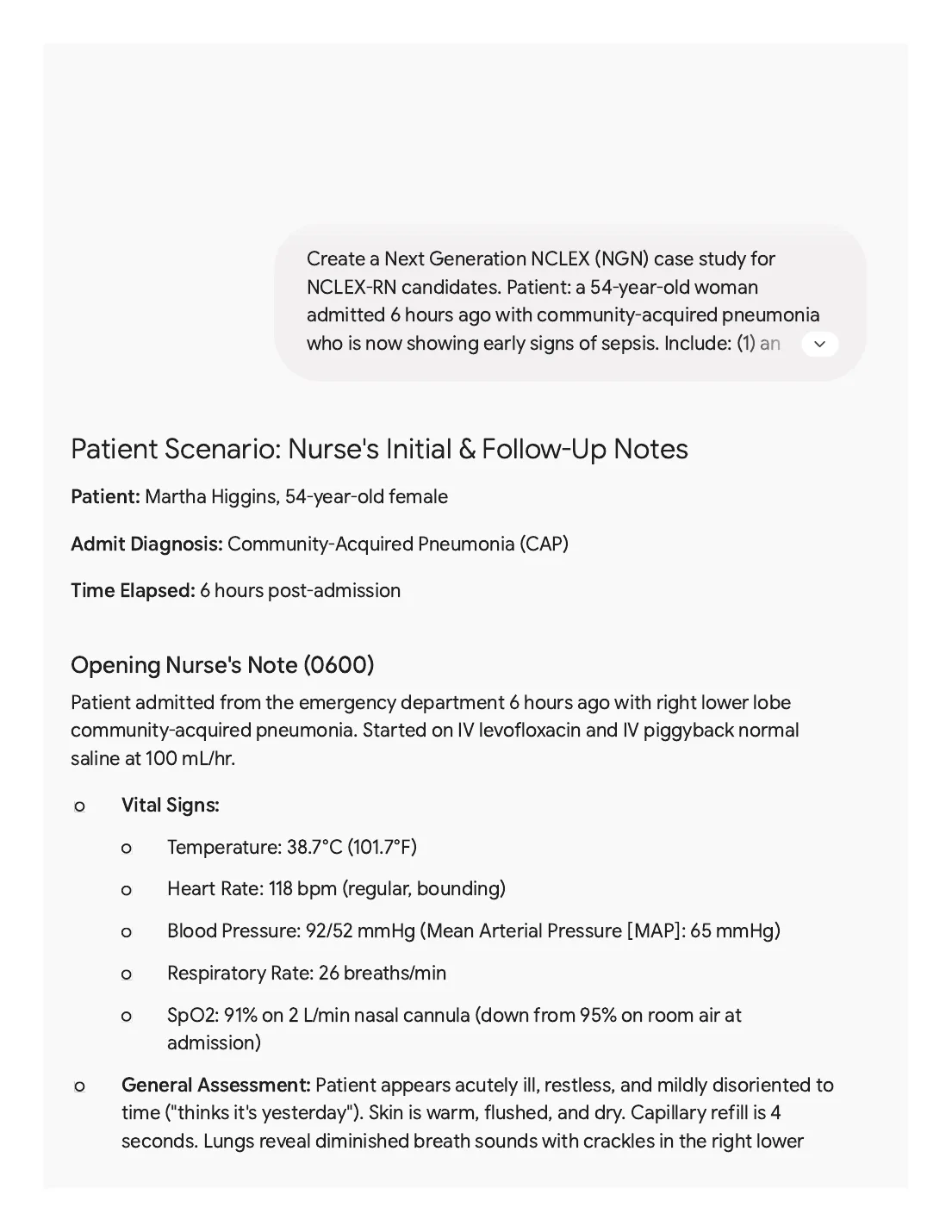
The comparison, side by side
| ChatGPT | Gemini | |
|---|---|---|
| Followed the format asked for | Yes, nurse's note, recognize-cues question, bow-tie and trend question, all in order | Mostly. It changed the trend question into a select-all-that-apply item, unasked |
| Answer keys | Strongest first key (urine output 25 mL/hr with new confusion); but its bow-tie key names septic shock while its rationale says the data do not yet establish that diagnosis | First key fails its own definition of hypotension: the patient is 92 systolic with a MAP of exactly 65, against a rule of "below 90 / below 65" |
| Numbers | One soft label: a blood pressure of 102/64 called "borderline hypotension" | MAP of 74 given for 104/64 (the arithmetic is about 77); urine output called "doubled" when it rose about 2.7 times; a lactate "trend" with no baseline |
| Rationales | Explained why every wrong option in the trend question was wrong | Named the patient unprompted; the note contradicts itself on pulses; it also inserted a link to an unrelated YouTube lecture inside the bow-tie item |
The verdict
On the two tools tested — one case study, run once in each tool: for full case studies in the format you asked for, ChatGPT is the safer starting point. It followed the format and wrote the soundest keys, though you must still check them against your textbook. Gemini makes a useful drafting partner for structure and wording, but its numbers cannot be trusted without a calculator beside you — draft with it, then check every number yourself. Either way, verification is not optional. Treat this as a smoke test, not a benchmark: one prompt, one run, two tools.
Where AI goes wrong on NCLEX questions
One prompt on one day, but these are the failure types candidates meet again and again.
Two correct answers, or a wrong key. AI writes distractors by feel. Sometimes two options are both right and the key is whichever came first; sometimes, as with Gemini's blood pressure answer, the key is a borderline value defended by a definition it fails. Real exam items are reviewed until only one answer survives. In an AI chat, you are the review panel.
Numbers and guidelines that drift. Lab ranges, MAP arithmetic, collection periods, dose calculations: small numeric slips are AI's most common clinical error and the hardest to spot, because the sentences around them read so confidently. Anything with a number gets checked, every time.
Questions that are too easy. AI stems hand you the diagnosis, and its wrong options are obviously wrong. Real items make you work for the cue. If AI practice feels comfortable, it is flattering you; your question bank scores are the honest measure.
The rule that covers all of it: if AI and your question bank disagree, trust the question bank and your textbook, and treat the disagreement itself as the lesson. The minutes spent finding out which one is wrong are among the highest-value minutes of your studying.
AI plus a question bank: the best combination
Put the two tools in their proper jobs and the weaknesses cancel out. The question bank, calibrated against real item statistics, is where you test: timed sets, honest scores, readiness decisions. NCSBN's free materials belong in the same column: test plan, candidate bulletin, and the official tutorial.
AI sits in the other column, the tutor who never sleeps: it explains the questions you missed, rebuilds your plan around the pattern of those misses, and drills the topic that keeps beating you. No specific paid product is recommended here on purpose; any established bank with rationales and category scores can fill the role.
The daily rhythm is the whole system: mornings test, evenings explain. Keep those jobs separate and AI becomes what candidates need, a second pair of eyes on their own thinking.
Frequently asked questions
Can ChatGPT predict whether I'll pass the NCLEX?
No. ChatGPT has no access to the passing standard and no calibrated estimate of your ability. It can review your practice patterns and tell you what to fix, which is valuable, but a pass prediction from a chatbot is a guess wearing a lab coat. Readiness belongs to timed question-bank assessments under exam conditions.
Are AI-generated NCLEX questions accurate?
The structure usually is; the details are not guaranteed. In this guide's test, both completed answers produced well-formatted NGN case studies, and both contained errors a student would miss: a key defended by a definition its own values did not meet, a MAP calculated wrong, a key at odds with its own rationale. Generate with AI for volume and variety, then verify every key against your textbook or question bank.
Can I use AI for NGN case studies?
Yes, and it is one of the best uses, because case studies are hard to find in quantity and AI produces endless variations on your weak topics. Two cautions: ask for the exact item types you want (recognize cues, bow-tie, trend), because tools drift into easier formats, and check the keys, because a case study built on one wrong premise teaches six wrong lessons.
Which free AI is best for NCLEX prep?
Split it by task, based on the test in this guide. For full case studies in the format you asked for, ChatGPT followed instructions most faithfully and wrote the soundest keys. Gemini produced a complete answer but made repeated numeric errors, so use it for drafts and explanations only with a textbook open. On every tool, verification is not optional.
Is AI enough, or do I still need a question bank?
You still need a question bank. AI cannot calibrate difficulty against real candidate data, cannot give you a trustworthy readiness score, and writes questions easier than the real exam. AI is the tutor; the question bank is the exam simulator. Testing in the bank and explaining with AI is the strongest low-cost combination.
Can internationally educated nurses use these prompts?
Yes. AI is especially useful for the parts of the NCLEX about convention rather than knowledge: US prioritization habits, delegation rules for LPNs and UAPs, documentation style. Add two instructions to any prompt: use US units and terminology, and follow the current NCSBN test plan. Where your home country's practice differs, ask it to flag the difference.
Final thoughts
Candidates rarely fail the NCLEX for lack of effort. They fail because the effort went to the wrong layer: memorizing content when the exam measures judgment, or collecting resources when they needed scored practice and feedback. AI, used in its lane, fixes the feedback problem for free, reading your mistakes with you every night for four weeks. Just never let it grade its own homework.
Studying the content itself? Start with 40 AI Prompts for Nursing Students for the wider toolkit, and if you are on the teaching side of this exam, 25 AI Prompts for Nursing Instructors covers lesson plans, item writing and OSCE work. For sharper prompting, read How to Write Better AI Prompts. Try the prompts right now in our free chatbot at chat.theaitoolplaybook.com.
Once you pass and start work, AI for Nurses (2026) picks up where this guide ends, with prompts for real shifts.
Once you are on the wards, a good brain sheet keeps every patient straight: our nursing brain sheets guide shows how to fill one in during a real shift, with 8 free printable templates.
Dosage calculations are guaranteed NCLEX territory. Practice them free with our Dosage Calculation Practice tool: unlimited med math questions with step-by-step answers, a timed exam mode and printable worksheets.