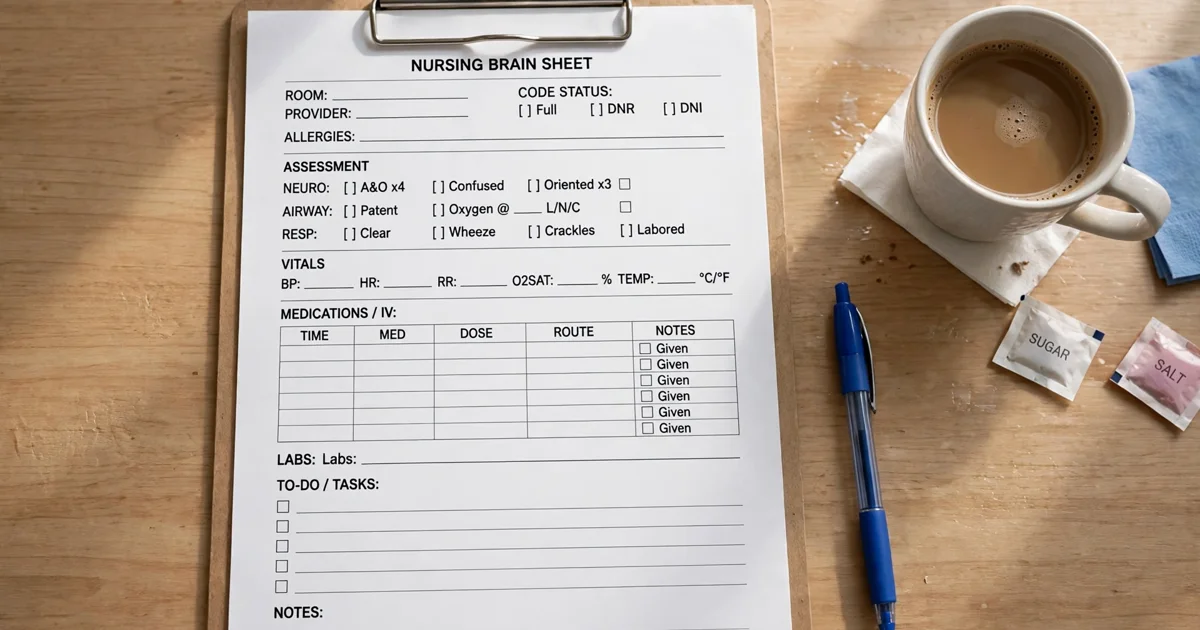
1. The first week
It is the first week on the ward. You have four patients, and your pockets hold the real chart. A lab value on a sticky note. A med time on a scrap of paper towel. A blood pressure on the back of your hand, half washed off. Report took twenty minutes per patient, and by the second room the first room is already blurry.
Every experienced nurse has watched a new graduate live this week, because every experienced nurse survived it too. The turning point is rarely a better memory. It is a better piece of paper: one sheet that holds the whole assignment. Who each patient is. What matters about them. What is due, and what to watch. Nurses call it a brain sheet, and the nurses who swear by it tend to use the same layout every single shift.
One line before we start. A brain sheet does not replace the chart, and it never will. It is a working copy for your pocket, a way to hold your shift in one place while the official record stays in the system where it belongs.
2. What is a nursing brain sheet?
A nursing brain sheet is a one page worksheet that a nurse fills in by hand during a shift. It pulls the key facts for each patient out of the chart and into one place: room, diagnosis, code status, allergies, key labs, meds by hour, tasks, and the few lines you will need when you give report. Some sheets hold one patient in depth. Others hold four or more patients at a glance.
Three terms get mixed up, so here is the short version.
| Sheet | What it is | When it is used | Who sees it |
|---|---|---|---|
| Brain sheet | Your own working notes for the shift | All shift, in your pocket | Only you |
| Report sheet | The same idea under a second name; on some units it means the printed assignment sheet | From the start of the shift | You, sometimes the charge nurse |
| SBAR handover sheet | A structured format for giving report: situation, background, assessment, recommendation | At handover | You and the nurse taking over |
In practice, brain sheet and report sheet mean the same thing on most units. SBAR is different: it is not a place to store your shift, it is a script for handing it over. The set below includes all three, because a good shift needs both a worksheet and a handover structure.
3. Download: 8 free printable templates
All eight templates are free, with no sign up. Each one fits a single page, and each comes in US Letter and A4. The hour strip on every sheet shows the day shift hours in large numbers and the night shift hours in small numbers, so the same sheet works on both shifts. Download the complete pack, or take only the sheets you need. The same set also lives on our free nursing brain sheets page, with a closer look at each sheet.
The complete pack
All 8 sheets in one PDF, ready to print.

Med-Surg Brain Sheet: 1 Patient
For one complex patient who needs the full picture on a single page: systems, labs, lines and an hour by hour plan.

Med-Surg Brain Sheet: 2 Patients
The everyday sheet for a light med-surg assignment, with room for two full patient pictures, one above the other.

Med-Surg Brain Sheet: 4 Patients
The standard shift sheet: four patients, each with systems, labs, meds by hour and a to-do list of their own.
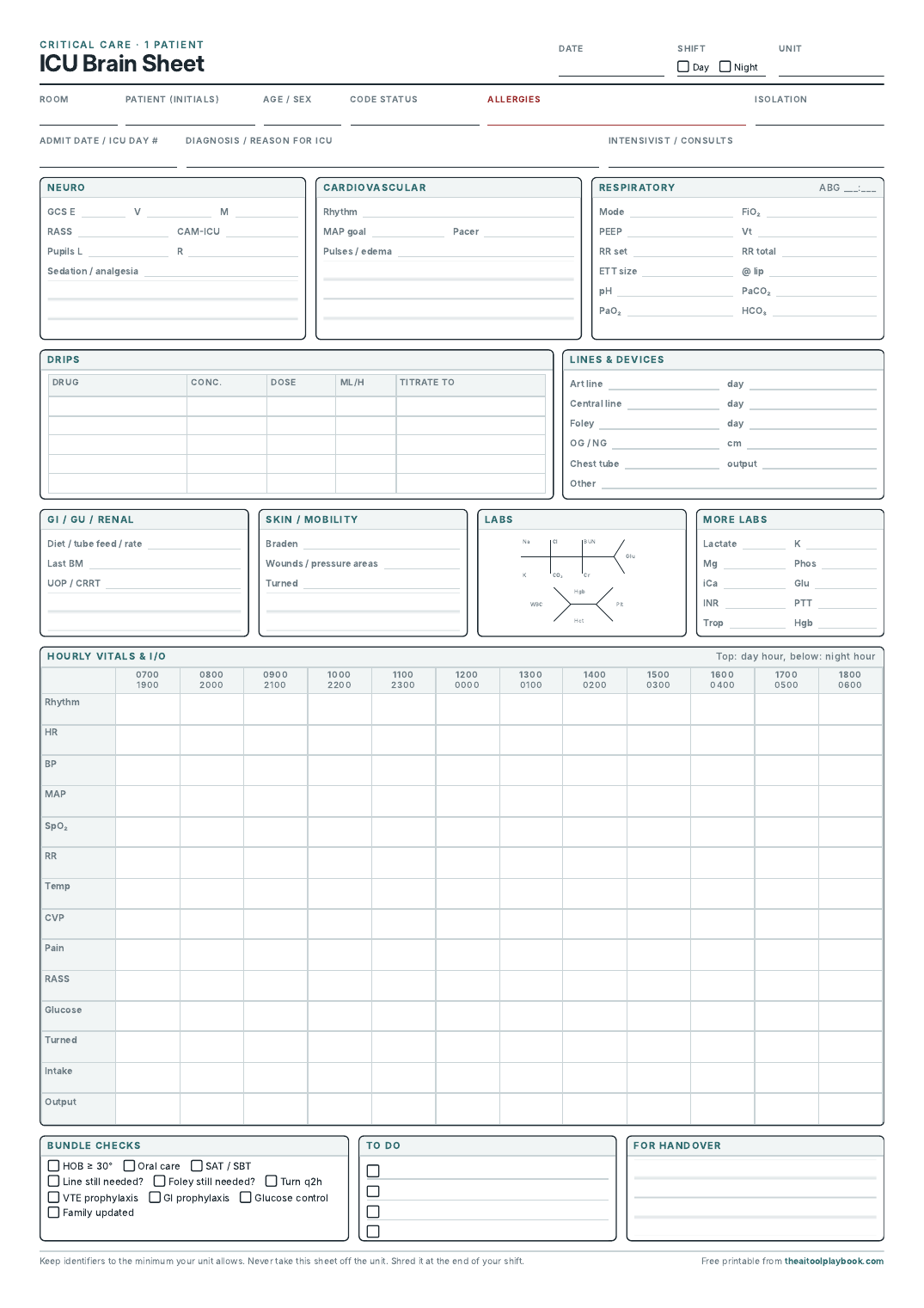
ICU Brain Sheet
Built for critical care: drip rates, ventilator settings, lines, hourly vitals and the daily bundle checks.
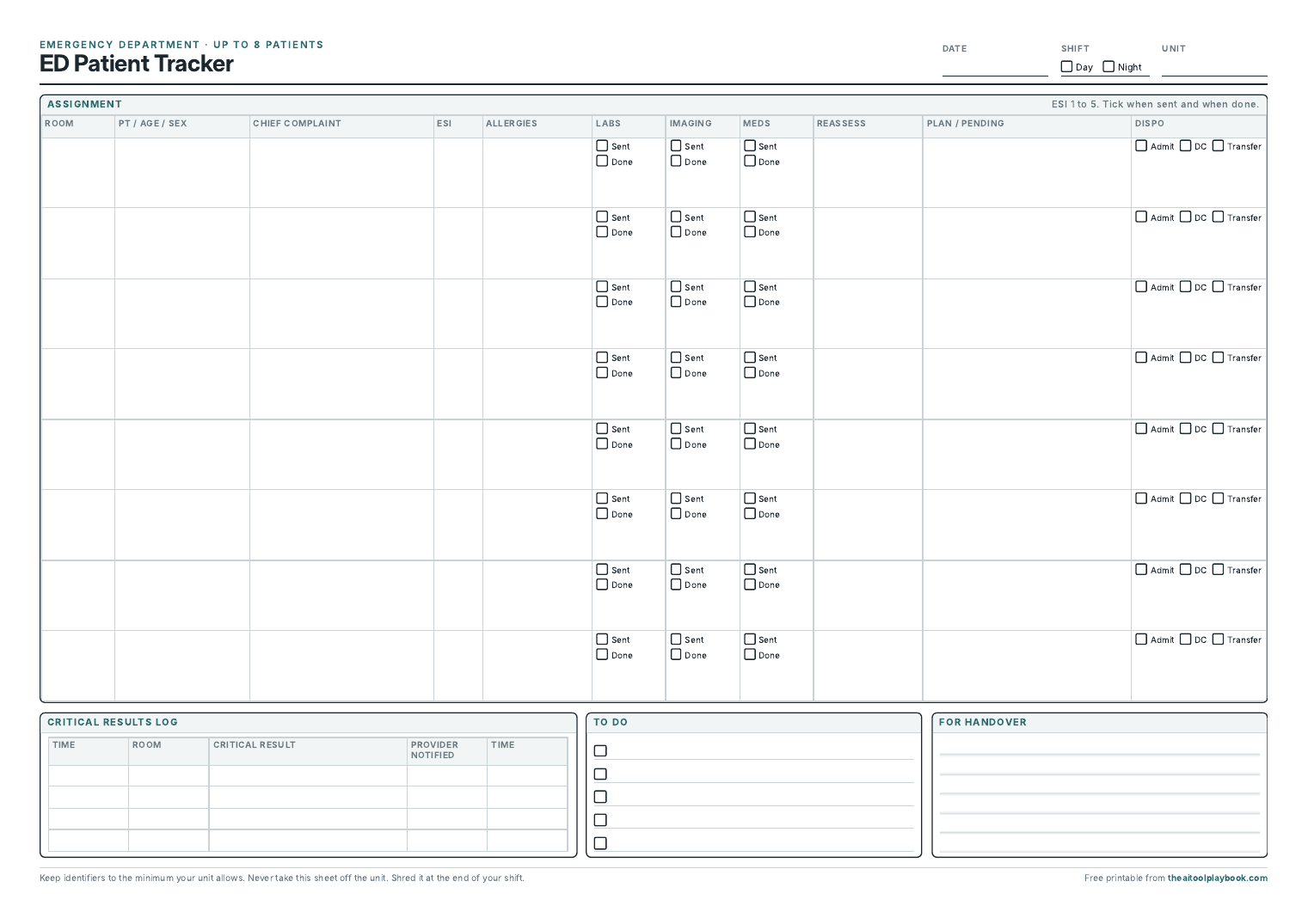
ED Patient Tracker (8 Patients)
A landscape tracker for fast turnover: eight patients, chief complaint, ESI, orders sent and done, and disposition.
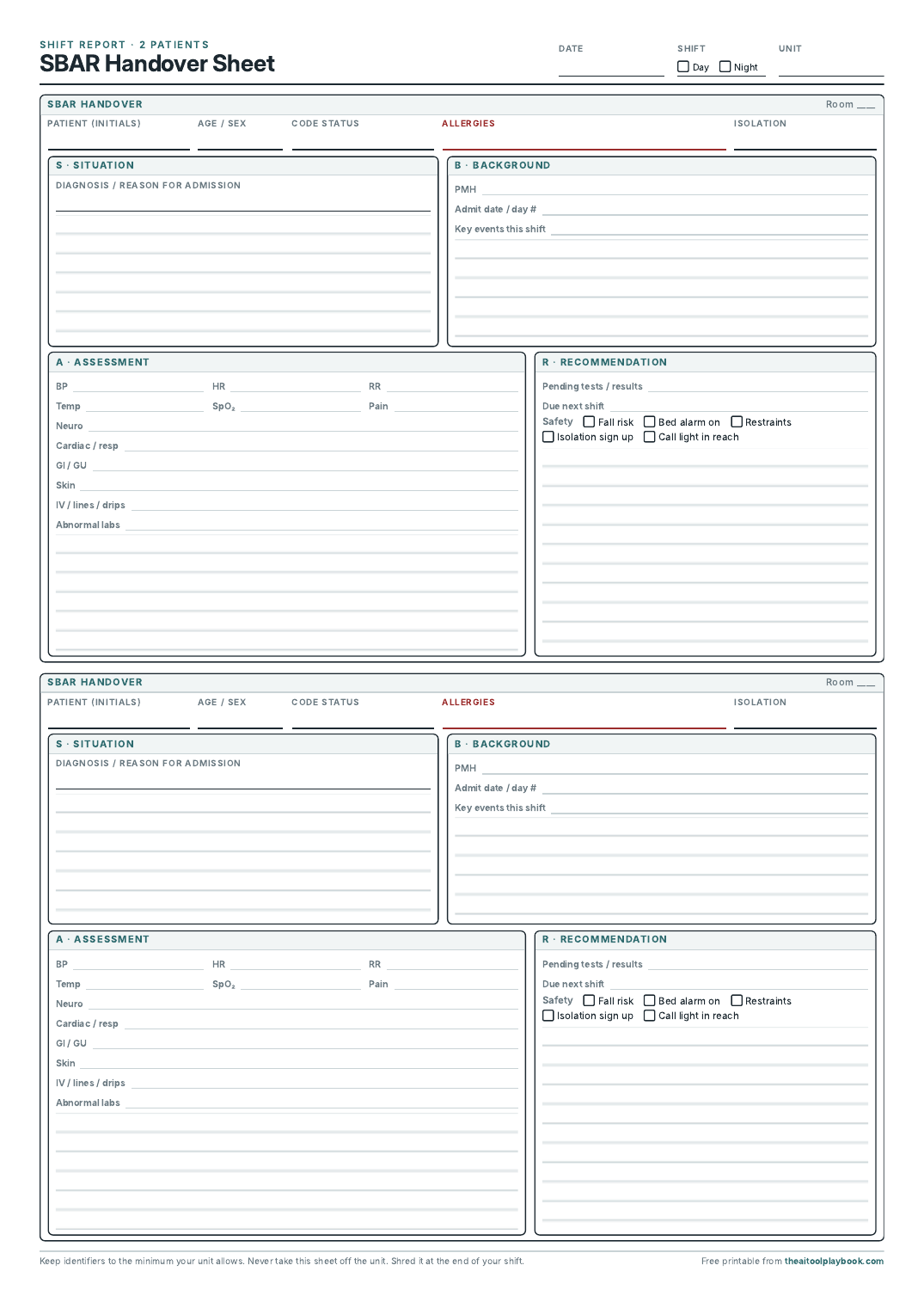
SBAR Handover Sheet
Two handovers per page in SBAR order, so report stays structured even at the end of a long shift.
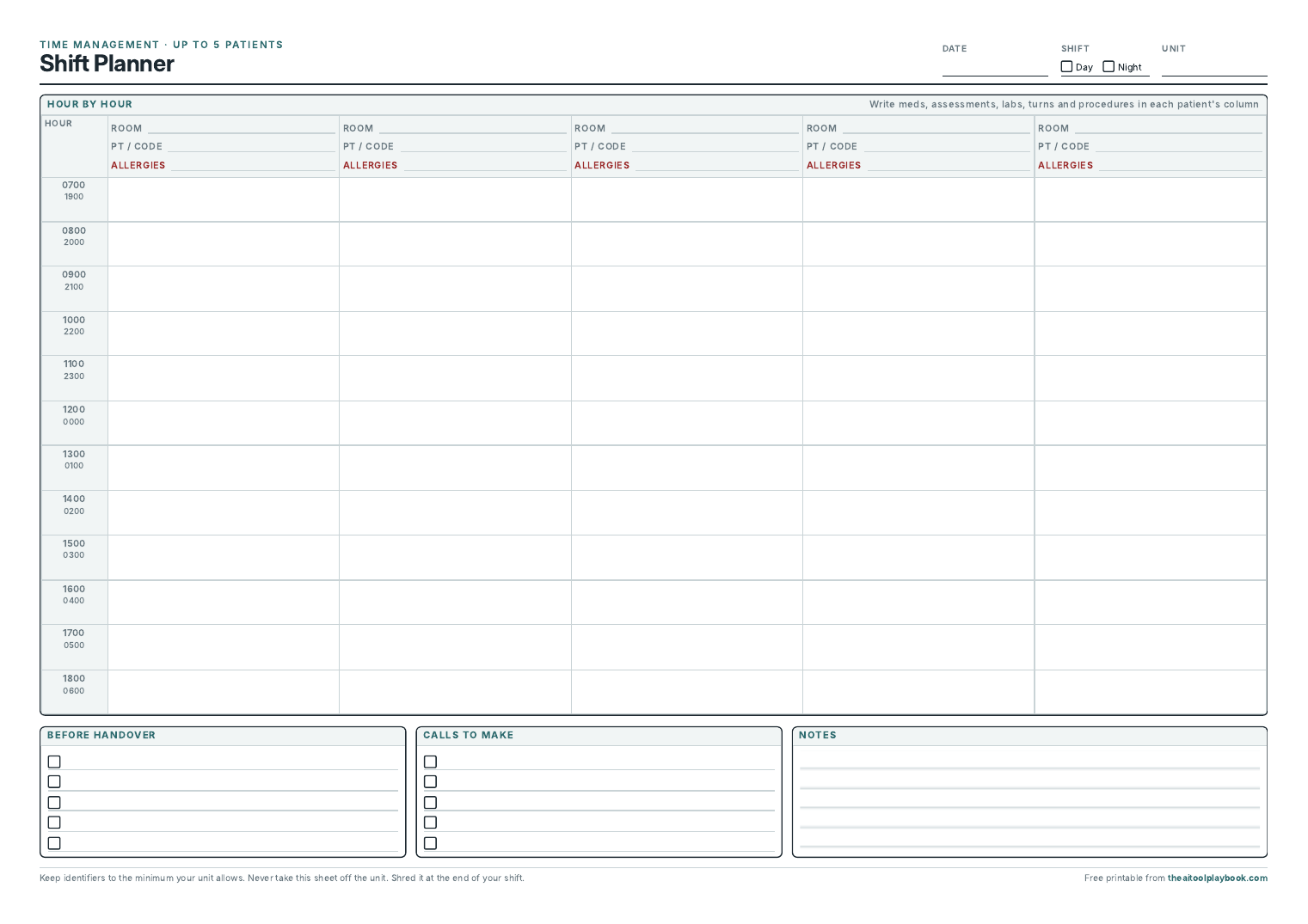
Shift Planner (5 Patients)
A landscape planner that spreads five patients across one page, organized around the hour strip.
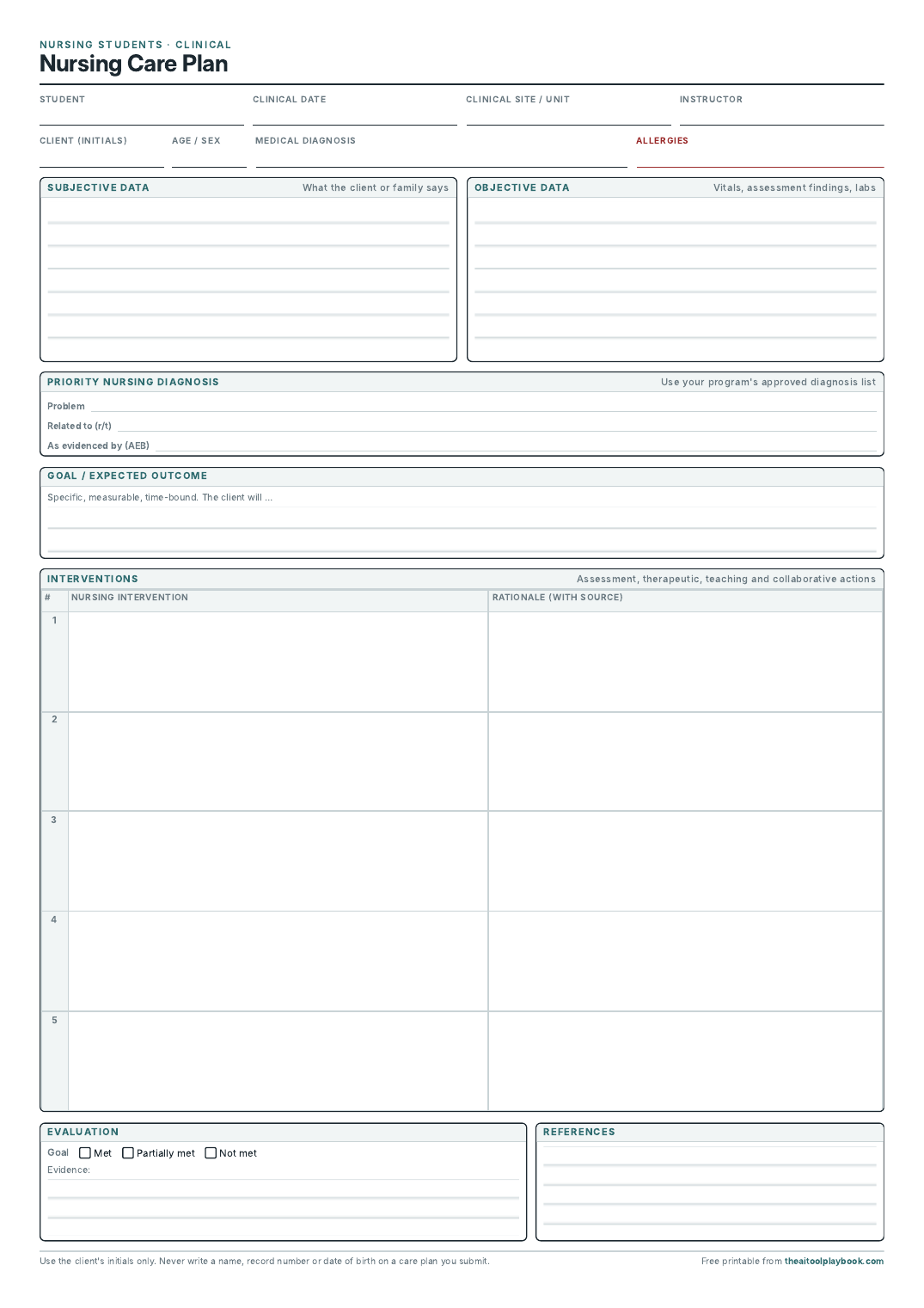
Nursing Care Plan (Students)
A student sheet that turns assessment data into a priority nursing diagnosis, goals, interventions and evaluation.
Which sheet should you choose?
New graduate on med-surg? Start with the 2 patient sheet, and move to the 4 patient sheet when the assignment grows. In the ICU, use the ICU sheet; nothing else here has room for drips and vent settings. On an ED rotation, take the tracker. Nursing students: the care plan sheet matches how your instructors want your thinking laid out. If you download only one, download the sheet that matches the assignment you actually get, not the one you hope for.
4. How to fill in a brain sheet during a real shift
A brain sheet only works if it is filled in the same way every shift. Here is the rhythm most nurses settle into.
Before report (15 minutes)
Arrive a few minutes early and take the skeleton from the chart or the assignment board: room, initials, age, code status, allergies, isolation, diagnosis. Write code status and allergies first, before anything else. Those two boxes are the ones you cannot afford to leave blank, and they take ten seconds while the facts are in front of you.
During report
Listen for the story, not the data dump. Write the diagnosis in your own words, the one or two things that could go wrong with this patient today, and anything time sensitive: a med due at nine, a test at ten, a family meeting at noon. Leave out the full history. If it will not change what you do this shift, it belongs in the chart, not in your pocket.
The first hour
After your first round, add the assessment: vitals, the systems that matter for this patient, lines and drains, and the latest labs. Then mark the hour strip. Write each scheduled med and task in its hour box, so the rest of the shift becomes a row of small boxes to tick instead of a list to remember.
During the shift
Tick tasks off as you finish them, not at the end. Update labs and vitals on the sheet when new ones land. When something changes, cross out the old plan and write the new one next to it. A sheet with crossings out is a sheet that kept up. A clean sheet at 6 p.m. usually means the sheet stopped being used at 10 a.m.
Before handover
Five minutes before report, fill in the For handover box: how the patient is now, what changed, what is still pending, and what the next nurse should watch. Then give report from the sheet, top to bottom. When the box is filled in, report takes half the time and misses half as much.
One patient, filled in step by step
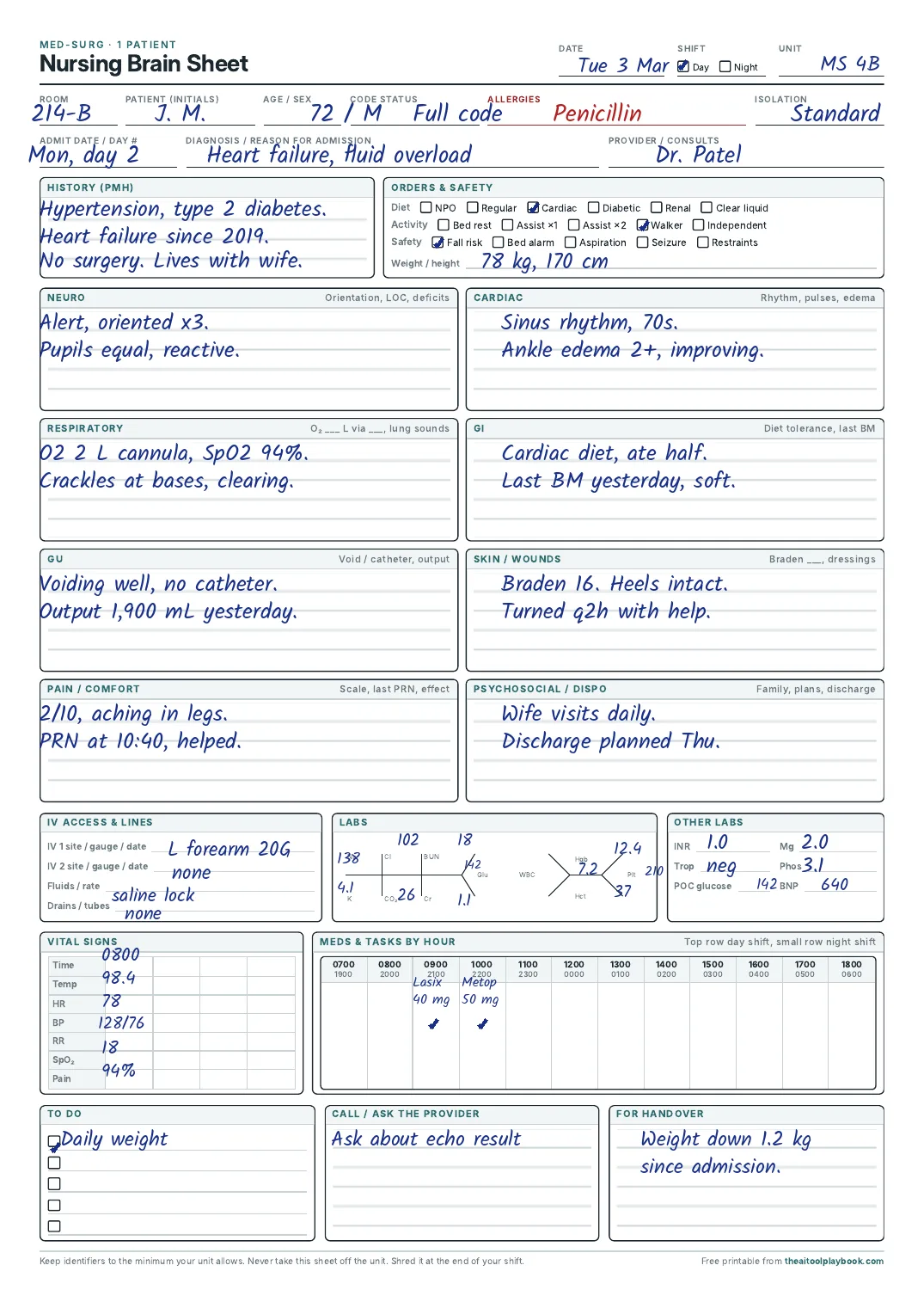
Meet Mr. M. He is invented, and any nurse on a med-surg floor has met him. He is 72, in room 214-B, on day two of a heart failure admission for fluid overload. His code status is full code. He is allergic to penicillin, and that went on the sheet in red before anything else.
From report, his nurse wrote the short story: hypertension and type 2 diabetes, heart failure since 2019, lives with his wife. She ticked the orders that shape the day: cardiac diet, walker for activity, fall risk on safety, and his weight, 78 kilos, because on a heart failure day the weight is a vital sign.
The first round filled the middle of the sheet. Alert and oriented times three. Sinus rhythm in the 70s, ankle swelling 2+ and improving. Oxygen at 2 liters, saturation 94 percent, crackles at the bases and clearing. The 8 a.m. vitals went into the first column, and the two morning meds went into their hour boxes: furosemide 40 milligrams at nine, metoprolol 50 at ten. Both are ticked, because both were given.
By the end of the shift, the sheet tells the whole day at a glance. Daily weight: ticked. The handover box carries the one line the night nurse needs first: weight down 1.2 kilos since admission. Nothing on this sheet is clever. That is the point. Every box did one small job, and together they held the shift.
5. Mistakes new nurses make with brain sheets
Most brain sheet problems are writing problems. These five show up again and again.
Writing too much
If your sheet becomes a second chart, you will stop updating it by midday. Write what changes your actions. Summaries, not transcripts.
Leaving code status and allergies for later
Later means during a rapid response, which is the worst time to go looking. First two boxes, every shift, no exceptions.
Not marking times
A med without an hour is a worry, not a plan. The hour strip only works if times go on the sheet when the orders land, not from memory at noon.
Changing sheets every shift
A new layout every day means a new search every time you look down. Pick one sheet and let your eyes learn where everything lives.
Taking the sheet home
It feels harmless, and it is the one mistake that can follow you. The sheet stays on the unit and goes in the shredder at the end of the shift. The next section is blunt about why.
6. Privacy rules: HIPAA and your brain sheet
A brain sheet holds real patient information, so treat it like the chart with shorter legs. While it can identify a patient, it is protected health information under HIPAA, and your facility rules apply to it in full.
Use the minimum identifiers your unit allows: initials and a room number, not a full name and date of birth. Keep the sheet in your pocket or at your workstation. Never leave it on a cafeteria table. At the end of the shift it goes into the confidential shred bin on the unit. Not the regular trash, and not your bag, even by accident. If your facility has its own brain sheet policy, that policy wins over anything on this page.
One more habit worth building now: never photograph a filled in sheet, not even to show a friend how your day went. The example sheet in this article uses an invented patient for exactly this reason.
7. Use AI to build your own brain sheet
Templates are a starting point. Your unit is not generic, though: your patient mix, your charting system and your med times are yours. This is where AI earns its place. Paste a prompt into ChatGPT, Claude or Gemini and ask it to design a sheet around your assignment. Then print a few copies and test them on real shifts.
Design a one page brain sheet for a med-surg nurse with 4 patients. Include for each patient: room, initials, code status, allergies, diagnosis, key labs, vitals, meds by hour and a to do list. Leave generous white space for handwriting.
Turn this list of things I track on my unit into a clean one page layout: [paste your list]. Group them the way a shift flows: before report, first round, during the shift, handover. Use checkboxes where a tick is faster than writing.
Design a brain sheet for a labor and delivery nurse. Include contraction timing, fetal heart rate checks, cervical exams, meds and a handover box. One page, with large writing space.
Here is the brain sheet I use now: [describe it]. I always run out of room for labs and my meds section is too small. Redesign the layout with more lab space and a bigger meds by hour strip, and keep everything else where it is.
Turn these handover notes about an invented patient into a 60 second SBAR report: [paste notes with invented details only]. Keep it in SBAR order and flag anything a night nurse should watch first.
Make your own sheet with AI, or start from the templates above. Either way, check the result against your unit's real needs, and never paste real patient details into an AI tool. Invented details only, always.
8. Frequently asked questions
What should be on a nursing brain sheet?
Room and initials, code status, allergies, diagnosis, the key assessment findings, latest labs, IV lines, meds by hour, a task list, and a handover box. If a box never changes what you do, it does not belong on the sheet.
Is a brain sheet HIPAA compliant?
A brain sheet can hold protected health information, so it has to be handled that way. Use minimum identifiers, keep it on the unit, and shred it at the end of the shift. Follow your facility policy first; it overrules any general advice, including this page.
How many patients can one sheet hold?
In this set, from one to eight. The med-surg sheets hold one, two or four patients, the shift planner holds five, and the ED tracker holds eight. Busier sheets hold less detail per patient, which is the right trade on fast units.
Do nursing students need a brain sheet?
Yes, and arguably more than anyone. Clinical days throw more new information at you than working shifts do. The care plan sheet in this set is built for students: it turns your assessment into a priority diagnosis, goals and interventions in the order your instructors grade.
Brain sheet or report sheet: what is the difference?
On most units, almost nothing. The two names usually mean the same one page worksheet. On a few units, report sheet means the printed assignment list instead. If your unit uses one of the terms in a specific way, follow your unit.
Can I edit these templates?
The PDFs are print ready as they are. If you need a different layout, the fastest route is the AI prompts in section 7 of this article: describe your unit and your patient count, and generate a sheet shaped around your shift. Recheck any generated layout against your unit policy before you rely on it.
9. Final thoughts and related guides
Back to that first week. Same nurse, same four patients, one change: a single sheet, filled in the same way every day. Report still takes time. The sticky notes are gone. The numbers are not on her hand anymore; they are in boxes her eyes can find without thinking. That is all a brain sheet ever promised to do, and it is enough.
If you want the AI side of nursing work next, read AI for Nurses, with 30 prompts for shift work, patient teaching and paperwork. Studying for the NCLEX? The NCLEX study guide builds a four week ChatGPT plan. Still in school, start with the AI prompts for nursing students. And if you teach, the nursing instructors guide has 25 prompts for case studies and exam questions.
Learning to write the care plan itself? Our step by step guide, How to Write a Nursing Care Plan, works through assessment, diagnosis, goals, interventions and evaluation with a full worked example on this same template.
The numbers on these sheets have to be right. Practice the math behind them free with our Dosage Calculation Practice tool: unlimited questions, step-by-step answers and printable worksheets.