This guide is for the people on the other side of the classroom: nursing instructors, clinical instructors and simulation faculty, in the US and everywhere else nurses are trained. If you teach students, our companion guide for your students is 40 AI Prompts for Nursing Students. This one is about your workload.
That workload has a shape most people outside nursing never see. A single week can hold lecture prep for two courses, care plans to grade, an exam to build, a simulation to run, clinical days on the ward, and a mailbox full of student messages. The teaching is the job you trained for. The drafting around it, outlines, rubrics, first versions of questions, is where the hours quietly disappear.
That drafting is exactly what AI is good at. So one line before anything else, because everything in this guide hangs on it: AI drafts, and the instructor decides. Every prompt below is written for the free plans of ChatGPT, Claude and Gemini, and one of them, the Next Generation NCLEX case study, was run in all three tools so you can compare what comes back. The results are further down.
The one rule: AI drafts, you verify
An AI answer can look polished and still be wrong: a lab range slightly off, a drug dose from an old guideline, an answer key that picks the second-best action. In a business course that costs points. In nursing it can teach a student something unsafe, which is why the checking step is not decoration on these prompts. It is the workflow itself.
- Check every clinical fact against your course textbook and current guidelines before anything reaches students. Values, doses, priorities, all of it.
- Never paste student names, grades or records into a free AI chat. In the US that is a FERPA problem, and it is just as bad practice everywhere else.
- Never build a scenario from a real patient. Change every identifying detail, or invent the patient from scratch. In the US, real patient data in a teaching scenario is a HIPAA problem waiting for a screenshot.
- Read AI exam items like a skeptical colleague wrote them. One defensible correct answer, no clues in the wording, distractors a real student might actually pick.
Follow those four and AI becomes what it should be in a nursing program: a fast junior assistant whose work you sign off, never the other way round.
How to get good results
Generic prompts get generic teaching material. The instructors who get real value from these tools give the same information they would give a colleague covering their class.
Start with your course level. ADN, BSN and LPN students are taught to different depths, and an item that suits a final-year BSN class will sink a first-semester group. Name the level, the topic, and the learning objective the material has to serve.
Name your frameworks. If your program works with Bloom's taxonomy, say which level you are targeting. For Next Generation NCLEX material, name the NCSBN Clinical Judgment Model and the skill you want exercised: recognizing cues, prioritizing hypotheses, taking action. The tools know these frameworks, and using their language pulls the answer into the right shape.
Give it your raw material. Your own lecture notes, last year's exam, your grading expectations in rough words. AI reorganizes and polishes far better than it invents, and starting from your material keeps your voice and standards in the result. The prompts below use brackets like [topic] and [course level] wherever your details belong.
New to prompting? These prompts follow the same structure taught in our guide to writing better AI prompts: role, task, context, format. Once you see the pattern, you can bend any of them to your course in seconds.
Lesson planning (prompts 1 to 5)
Good lesson plans share a skeleton: objectives first, then activities that serve them, then a check that the learning landed. These five prompts follow that order.
Prompt 1: measurable learning objectives
Vague objectives produce vague teaching. The matching activity and check in this prompt stop that: if an objective cannot be checked, the prompt exposes it before your students do.
Prompt 2: a 50-minute lecture outline
Ask for the questions to ask the class, not just content. Silence after "any questions?" is a planning problem, and planned questions fix most of it.
Prompt 3: a case-based active learning activity
Read the facilitator note carefully before class, and keep this output in your own file. It is the part students never see.
Prompt 4: a flipped classroom assignment
Flipped classrooms fail when the pre-work feels pointless. Planning how class opens with their preparation is what makes students do it next time.
Prompt 5: one hard concept, three ways
Every cohort has students who think in stories and students who think in lists. Three versions cost one prompt and save the same question answered six times after class.
Assessment and NCLEX prep (prompts 6 to 11)
Item writing is the most skilled work in this guide, and where AI needs the firmest supervision. Used well, it drafts and varies items at a speed no faculty member can match at midnight. Used carelessly, it produces confident questions with debatable keys. Draft with it, then edit like an examiner.
Prompt 6: NCLEX-style multiple-choice items
The clause about the tempting wrong option matters: a distractor nobody picks tells you nothing, and this pushes the tool towards distractors based on real misconceptions.
Prompt 7: a Next Generation NCLEX case study
This is the prompt I put through all three tools for the test in this guide, word for word as written here. The comparison is further down, screenshots included, because NGN items are where the tools differ most.
Prompt 8: a care plan grading rubric
Consistency across graders is the quiet fairness issue in every nursing program. A rubric like this will not remove judgment, but it stops two students getting different grades for the same work.
Prompt 9: check your own exam items
Most instructors write decent questions and flawed options. This pass catches the classic faults, including the correct option that is twice as long as the rest.
Prompt 10: a test blueprint
The flag at the end is the valuable part. Blueprints drift as exams get edited year after year, and objectives quietly lose their questions.
Prompt 11: remediation questions
Remediation that repeats the failed question teaches memorising, not thinking. Fresh questions on the same idea, with the thinking error named, give students a real second route in.
Simulation and OSCE (prompts 12 to 15)
Simulation and OSCE work runs on paperwork: scenarios, checklists, scripts, debrief plans. The OSCE station is called a skills check-off in many US programs, and the paperwork burden is much the same either way. Detailed, structured writing is some of the best AI drafting territory in nursing education, as long as a clinician reads every line before a student meets it.
Prompt 12: a simulation scenario
Check the vital sign progressions as carefully as a drug calculation. A scenario whose numbers move the wrong way teaches the wrong reflex, and students remember simulation vividly.
Prompt 13: an OSCE checklist
"Observable actions" is the phrase doing the work here. Checklists full of judgments like "performed competently" produce arguments at grade review. Checklists of visible steps mostly do not.
Prompt 14: debriefing questions
A debrief lives or dies on its questions, and tired facilitators ask the same three every time. A prepared set keeps the analysis phase honest, especially about what was missed.
Prompt 15: a standardized patient script
Actors improvise unevenly, and uneven actors make uneven exams. A script with fixed answers to the common questions keeps every student's station close to the same test.
Clinical teaching (prompts 16 to 20)
On the ward there is no time to compose good questions, so the instructors who ask them prepare them the night before. These five prompts build the conferences, questions and feedback language for a clinical day, from your own notes about your own students.
Prompt 16: pre-conference questions
The answer points turn this from a question list into a listening guide: knowing what a good answer must contain is what lets you assess six students in fifteen minutes.
Prompt 17: post-conference reflection questions
Reflection questions fail when they sound like an essay assignment. Short, spoken, and tied to one real moment from the day gets honest answers instead of performance.
Prompt 18: clinical judgment questions
One question shape, five turning points. Students start anticipating the pattern, which is the habit you are building: something changed, so what happens next, and why.
Prompt 19: feedback for a struggling student
Only paste facts, never the student's name or record details, and rewrite anything that does not sound like you. Feedback is a relationship, and students can tell when the words are not their instructor's.
Prompt 20: clinical evaluation comments
That last clause earns its place at appeal time. Comments built from observed facts survive scrutiny; comments built from impressions are the ones that get challenged.
Admin and communication (prompts 21 to 23)
Every faculty member knows this pile: the syllabus clause, the announcement, the difficult email. None of it is teaching, all of it is the job.
Prompt 21: a syllabus section
Prompt 22: a class announcement
Prompt 23: replying to a grade complaint
Note the instruction inside this one: name removed. Complaint emails get pasted in a hurry, which is exactly when identifiable details slip into free AI tools. Strip them first, every time.
AI policy and academic integrity (prompts 24 and 25)
Your students are using these tools too, and the students' guide on this site teaches them prompts openly. The answer is not pretending otherwise. It is a written policy with clear zones, and assignments built so the learning cannot be outsourced.
Prompt 24: a course AI-use policy
Adapt the zones to your institution's policy before this goes anywhere near a syllabus. A course policy that contradicts the university's helps nobody in a dispute.
Prompt 25: an assignment AI cannot do for them
This works better than detection tools, which are unreliable and put you in the role of police officer. Design the shortcut out, and most students stop looking for it.
My test: one prompt, three tools
Advice about exam questions is cheap, so here is evidence instead. On November 5, 2026, I ran Prompt 7 from this guide through ChatGPT, Claude and Gemini, word for word as it appears above, in a fresh chat in each tool, all on free plans. Same patient, same instructions, no follow-up help. Then each answer was checked the way an instructor would check it: every element present, difficulty actually rising, clinical content sound.
ChatGPT: followed the brief most faithfully
ChatGPT was the only tool that delivered every element exactly as specified, including the single-answer multiple-choice question. Its answer, about 900 words, opened with the heading "NGN Case Study: Acute Decompensated Heart Failure" and a nurse's note whose numbers held together: blood pressure 158/94, heart rate 112, saturation 89 percent on room air, 2.3 kg gained in two days, BNP 1,240. Its rationale for the first question was the kind of sentence you want students to internalize: "The most important cues are worsening dyspnoea, crackles, and weight gain, which together point to fluid overload and worsening heart failure."
Then came the catch. In Question 3, its trend table shows potassium falling from 4.1 to 3.4 and creatinine rising while weight still climbs, yet its answer key says to give the IV furosemide as scheduled and continue monitoring. Holding the dose and notifying the provider is at least as defensible, and plenty of instructors would mark that key wrong. Its bow-tie also listed "administer IV furosemide" as an action when its own nurse's note said the drug had been given two hours earlier. A good draft with a contestable key: the point of this guide in one answer.
Claude: the richest case study, with one wrong number
Claude wrote the most complete answer, about 1,100 words: a proper three-column bow-tie table, a trend table running over three time points and nine parameters, and difficulty labels on each question, which the prompt did not even ask for. Its first rationale was precise: "The hypoxemia (A), pulmonary crackles (C), rapid weight gain (E), and S3 gallop (G) all point to excess fluid volume and pulmonary congestion in a client with HFrEF."
Two things needed an instructor's pen. First, Question 1 quietly became a select-all-that-apply item with seven options and four correct answers, not the single-answer question requested. In fairness, that is closer to how real NGN cue-recognition items often behave, but on an exam the format is part of the specification. Second, a small arithmetic slip in the Question 3 rationale: creatinine described as risen "about 0.6 mg/dL from the admission value", when its own table shows 1.5 rising to 1.9, which is 0.4. The 0.6 is the rise above the patient's baseline, and the conclusion, that this meets the threshold for acute kidney injury, still stands.
Gemini: a good case with a broken answer key
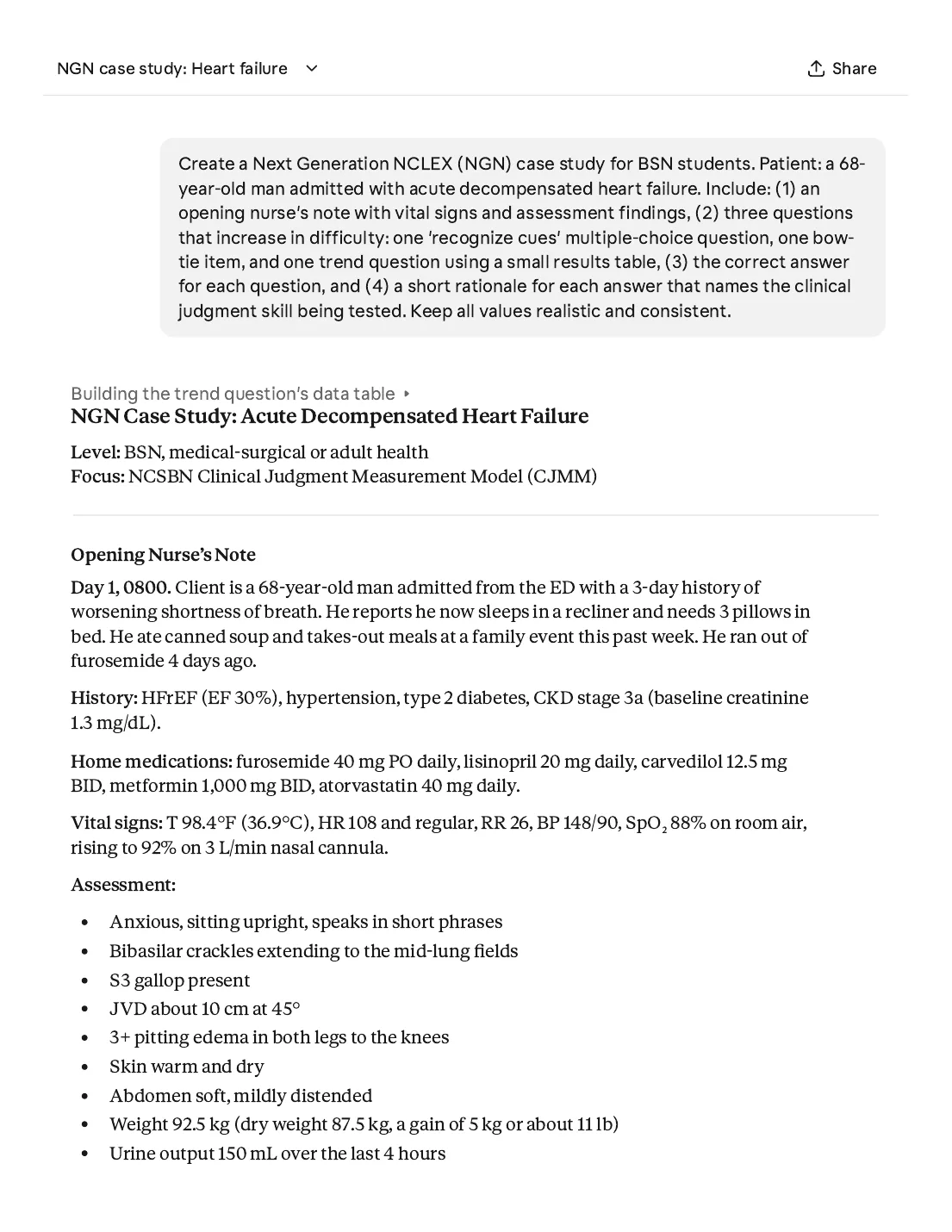
Gemini's answer was the shortest, about 700 words, and in some ways the most clinically sensible. Faced with the same pattern in its trend question, rising weight, falling potassium, rising creatinine, its key chose the cautious action: hold the next furosemide dose and notify the provider.
But its Question 1 disqualifies the answer as it stands. Gemini also turned the question into a select-all-that-apply item, then contradicted itself about the answer: the answer line gives two options as correct while the rationale beneath it names three. An exam item whose key disagrees with its own rationale cannot go near students until an instructor rewrites it. One transparency note: Gemini was run signed out and its chat was never saved, so it could not be re-opened to check its wording line by line. That is why this section quotes the other two tools and only describes Gemini, and why the screenshot below comes from a repeat run of the same prompt later the same morning.
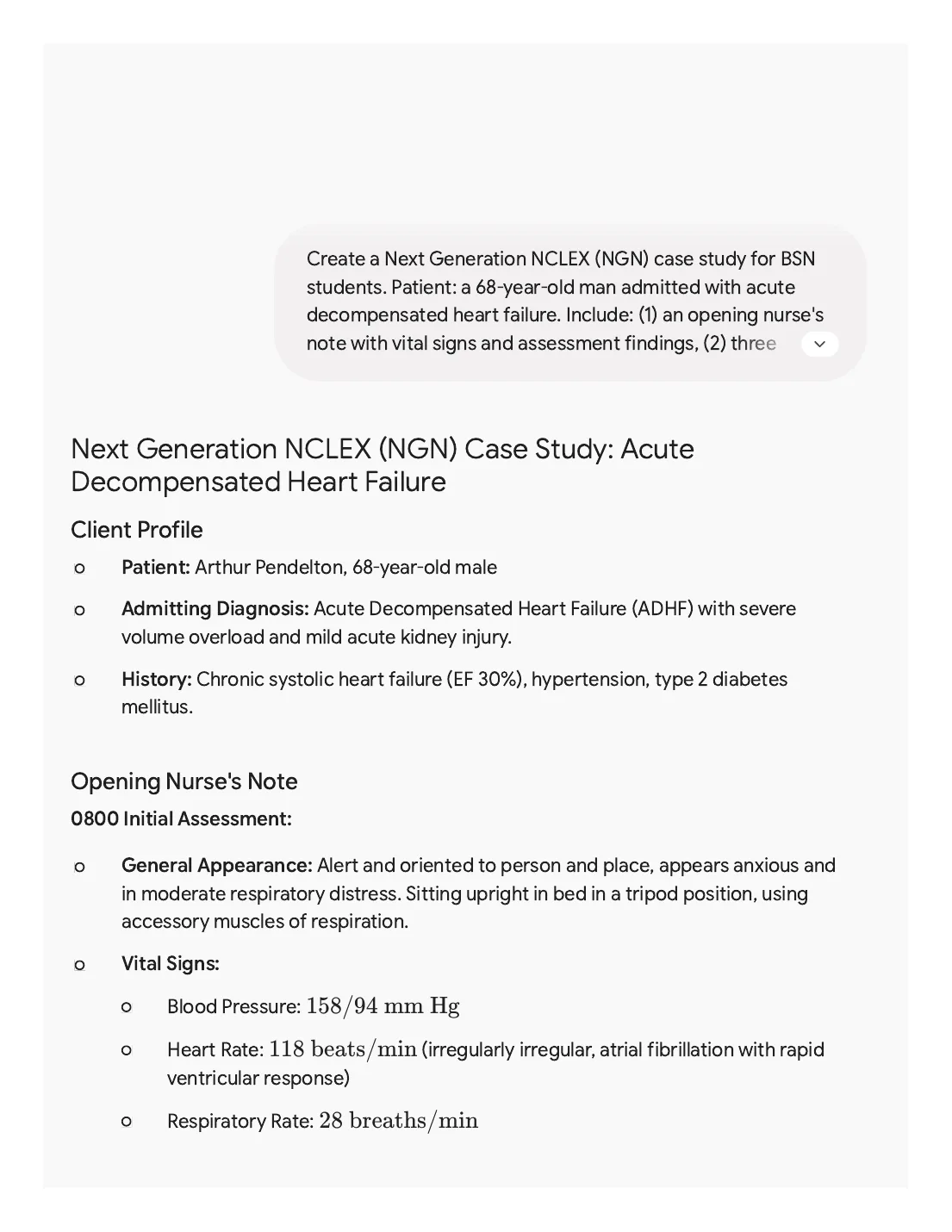
| Checked point | ChatGPT | Claude | Gemini |
|---|---|---|---|
| Elements requested | All six | All six | All six, first question in a changed format |
| Question 1 as asked (single answer) | Yes | No, select all that apply | No, select all that apply |
| Answer key consistency | One contestable key (Question 3) | Consistent | Contradicts itself on Question 1 |
| Clinical slips | Bow-tie repeats a dose already given | One arithmetic slip in a rationale | Values sound; the key is the problem |
| Approximate length | 900 words | 1,100 words | 700 words |
| Usable after | Adjudicating Question 3 | Correcting one number | Rewriting Question 1 and its key |
The verdict. Split the honors. For format discipline, ChatGPT: it built the item that was actually specified. For depth, Claude: the case study an instructor would most enjoy editing, with a single error that was arithmetic, not judgment. Gemini wrote a sensible patient and then failed the basic clerical test of agreeing with itself. The finding that matters is the one all three share: every tool produced a plausible, well-organized case study, and every tool needed an instructor's check before it could touch a student. That is not a reason to avoid them. It is the description of how to use them.
Safety rules, in five short points
- Verify before you teach. Every clinical fact, value, dose and answer key gets checked against your textbook and current guidelines. No exceptions for "it looked right".
- Protect student data. No names, grades, IDs or records in free AI chats. Strip identifiers from anything you paste, including complaint emails and your own feedback notes.
- Invent your patients. Scenarios and case studies use fictional patients or details changed beyond recognition. Real patient data never goes into a teaching document built with AI.
- Disclose the drafting. If your institution asks, be able to say which materials AI helped draft and how you checked them. Keeping the prompts you used, like the ones in this guide, makes that easy.
- Your name is on it. Whatever reaches students carries your professional responsibility, whatever drafted it. If you would not defend it in a grade appeal, it does not go out.
Frequently asked questions
Can nursing instructors use ChatGPT to write exam questions?
Yes, as a drafting tool. AI writes plausible NCLEX-style items quickly, including Next Generation NCLEX formats. But every item still needs your check: clinical accuracy, one clearly correct answer, fair distractors, and a match to your test blueprint. Treat AI items the way you treat items from a new colleague, useful drafts that you edit before they reach students.
Are AI-generated NCLEX questions accurate?
Not always. In testing for this guide, the tools produced well-structured case studies, but values, priorities and rationales still needed checking against current references, and the tools differed in how complete their items were. Use AI to draft and vary items, then verify every clinical fact and answer key yourself.
Is it ethical to use AI for grading feedback?
Yes, if the judgment stays yours. Instructors commonly use AI to turn their own rough notes into clear, fair feedback wording. The line you should not cross is pasting identifiable student work, grades or records into a free AI chat, which raises FERPA problems in the US. Grade the work yourself, keep names and records out, and let AI help only with phrasing.
How do I stop students from misusing AI?
A clear written policy helps, but assignment design helps more. Ask for de-identified reflections on the student's own clinical patients, require them to compare sources they chose themselves, and add short in-class defenses of their choices. Work that depends on their own experience is hard to outsource, and the policy tells them exactly where the lines are.
Which free AI tool is best for nursing educators?
In the test in this guide, it split by task: ChatGPT followed the requested NGN format most faithfully, Claude wrote the most complete case study, and Gemini's answer was the shortest but contradicted itself on an answer key. All three run on free plans. The practical answer for most educators: draft in ChatGPT or Claude, then verify the item yourself, because every tool needed an instructor's check somewhere.
Final thoughts
Nothing in this guide asks you to hand over the parts of teaching that matter: judgment about what your students need, the fairness of an exam, the honesty of feedback. It asks AI to carry the first drafts, the part that eats evenings. Keep the rule from the top of this page, and the time it gives back is real.
For the other side of the classroom, share 40 AI Prompts for Nursing Students with your cohort. To sharpen your own prompting, read How to Write Better AI Prompts, and for the wider free-plan picture, see ChatGPT vs Claude on free plans and Claude vs Gemini. You can also try every prompt in this guide right now in our own free chatbot at chat.theaitoolplaybook.com.
Teaching students who are preparing for the exam? How to Use ChatGPT to Study for the NCLEX (2026) shows the student side: a 4-week plan built on the same prompts approach.
For your students once they are working: AI for Nurses (2026) covers the prompts staff nurses use for handovers, patient teaching and charting.
Teaching students to run an organized shift? Our nursing brain sheets guide walks through filling in a brain sheet step by step, with 8 free printable templates.
For the student side of the same skill, share How to Write a Nursing Care Plan with your class: a step by step guide with a worked example students can follow.
If you also teach in a school classroom, our companion guide AI for Teachers: 10 Ways to Save Hours Every Week covers the same ground for school teachers.