
1. The night before it is due
It is 11 p.m. A care plan is due at 7 a.m., and the template on the screen is still blank. You met the patient today. You took pages of notes. But the first box asks for a nursing diagnosis, and your mind goes empty. Where do you even start?
Picture the student instructors describe every term. She arrived at the pre-conference with pages of copied chart notes and no idea which three facts mattered most. Her instructor asked one question: which of these numbers worry you? Twenty minutes later the clusters were sorted, the diagnosis was chosen, and the plan was written. Nothing about her knowledge changed in those twenty minutes. Only the order did. The diagnosis was hiding in her notes the whole time.
That is the secret this guide is built on. A care plan is not a form. It is your clinical thinking on paper. Each box answers one question, in a fixed order. What did I find? What is the problem? What will I do about it, and why? Did it work? Learn the order, and the blank page stops being scary.
2. What a nursing care plan is, and why instructors care
A nursing care plan is a written plan that connects what you found in your assessment to what you will do about it, and to how you will know whether it worked. It names the patient's nursing problems, sets goals, lists your actions with the reasons behind them, and records the result.
A care plan follows the nursing process, which has five steps. Assessment means collecting data about the patient. Diagnosis means naming the problem the data points to. Planning means setting goals and choosing interventions. Implementation means carrying those interventions out. Evaluation means checking the result and adjusting the plan. Every section of a care plan template matches one of these steps, which is why the steps must stay in order.
One thing confuses new students. A student care plan is much longer and more detailed than the care plans working nurses use, because hospital plans live inside the charting system and cover only active problems. Yours is a learning tool. Your instructor is grading your reasoning, not just your conclusions, and that is why the rationales in step 5 carry so much weight.
3. Download the free care plan template
Start with a template that follows the steps in order. The sheet below is the Nursing Care Plan template from our free brain sheets set. It puts subjective and objective data side by side, gives the diagnosis its three lines, reminds you inside the goal box to keep the goal measurable, and leaves a wide column for rationales. Print it, and fill it in as you work through the steps.
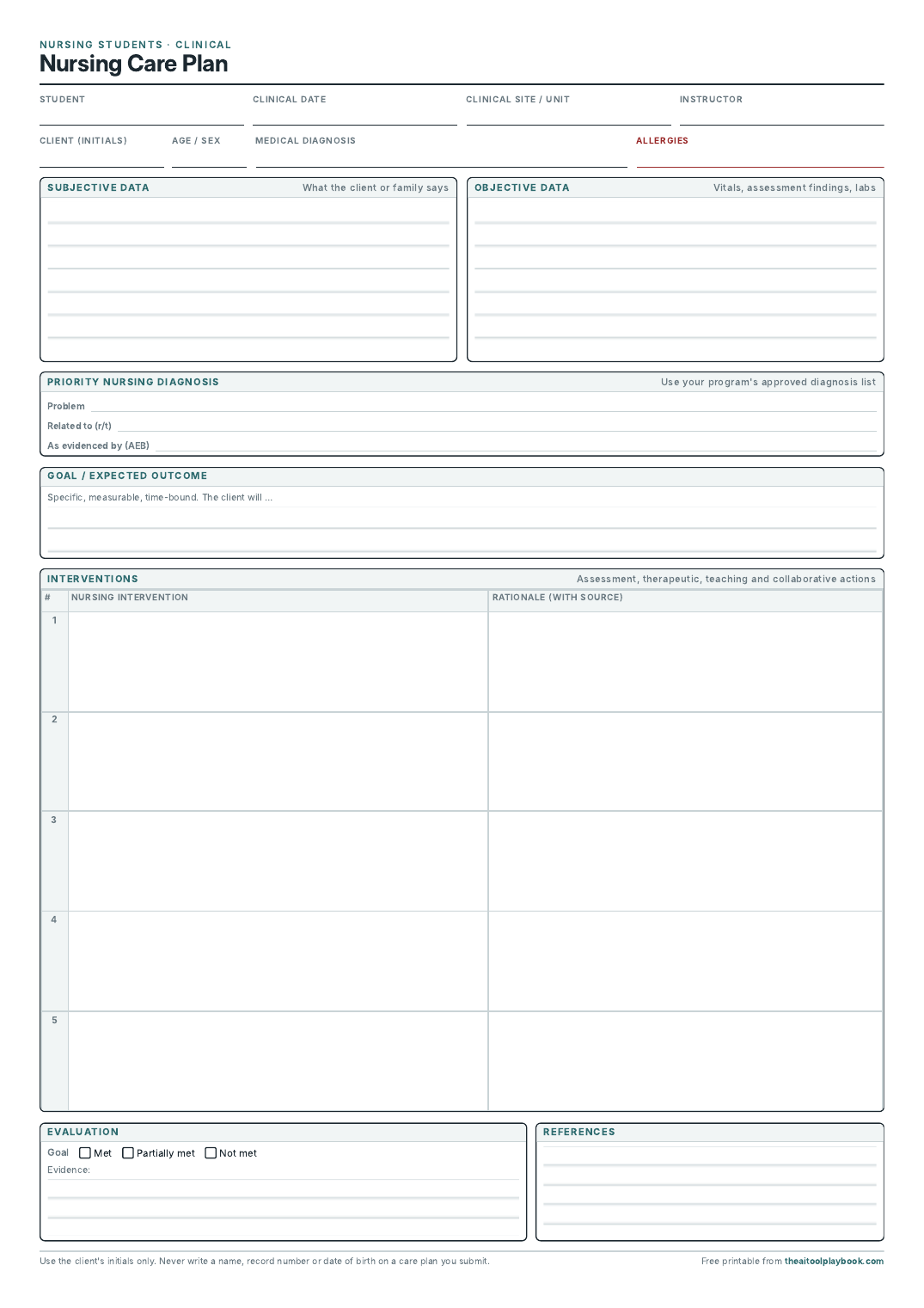
Download US Letter (PDF) Download A4 (PDF)
The care plan sheet is one of eight free sheets. The complete set, including brain sheets for med-surg, ICU and ED shifts plus the SBAR handover sheet, is on the free nursing brain sheets page.
4. Step 1: Assessment, collecting the right data
Every care plan stands or falls on its data. Assessment data comes in two kinds, and a good plan keeps them separate. Subjective data is what the patient or family tells you, in their own words: "I can't catch my breath when I walk." Pain ratings, nausea, fear and poor sleep are all subjective data. You cannot measure them, but they are real, and they belong in the plan in the patient's own words where you can.
Objective data is what you observe and measure yourself. Vital signs, oxygen levels, lung sounds, lab results, intake and output, and what you see when the patient moves are all objective data. Numbers and findings, written exactly as you found them.
Next, cluster the data. Clustering means grouping the findings that point to the same problem. Breathlessness, a low oxygen level, fast breathing and crackles in one lung belong in one cluster. A fever and a high white blood cell count belong in another. Each cluster becomes one possible diagnosis in step 2. Clustering is the step students skip most often, and it is the step that makes the diagnosis almost choose itself.
A tip that saves pages: write only the data that supports your diagnosis. A long list of normal findings buries the problem and tells your instructor you could not decide what mattered. If a fact does not help prove your diagnosis, it stays in your notes, not in the plan.
5. Step 2: The nursing diagnosis
A nursing diagnosis names a problem that nursing care can treat. It is not the disease. The table below shows the difference, and it is worth learning before you write a single line.
| Nursing diagnosis | Medical diagnosis | |
|---|---|---|
| Made by | The nurse | The physician or provider |
| Names | The patient's response to the illness | The disease or condition itself |
| Example | Impaired Gas Exchange | Pneumonia |
| Treated by | Nursing interventions | Medical treatment, such as antibiotics |
An actual nursing diagnosis has a three part format. The problem comes first, taken from the approved diagnosis list your program uses, which is usually the NANDA-I list. Then related to, often shortened to r/t, names the cause or the factors contributing to the problem. Then as evidenced by, shortened to AEB, lists the signs and symptoms from your own assessment that prove the problem is real. Joined together, the three parts read as one sentence: the problem, related to its cause, as evidenced by your data.
Each part has a job. The problem must be something your interventions can change. The related to part must name a cause a nurse can act on, such as inflammation, weakness or pain, and it must never be a medical diagnosis. The AEB part is your proof. Every item in it must come from the data you collected in step 1. If you cannot fill the AEB line from your own notes, the diagnosis is not ready, and the honest move is to go back and assess again.
Risk diagnoses work differently. A risk diagnosis starts with "Risk for" and names a problem that has not happened yet. Because there are no signs and symptoms yet, there is no AEB part. Instead, the second part lists the risk factors that make the problem likely. Risk for Falls, for example, is supported by factors such as muscle weakness, a new medication and an unfamiliar room.
6. Step 3: Prioritizing, choosing what comes first
Most patients give you data for several diagnoses. Most assignments ask for one priority diagnosis written in full, or your top three ranked in order. Ranking is a safety skill, not a guessing game, and three rules do most of the work.
First, the ABCs. Airway problems come before breathing problems, breathing problems come before circulation problems, and all three come before everything else. Second, Maslow's hierarchy. Basic physical needs such as oxygen, fluids and safety outrank comfort, teaching and emotional needs. Third, acute before chronic. A new, unstable problem outranks a long term problem that is stable and unchanged.
Here is the ranking for the patient you will meet in the worked example below, a 68 year old with pneumonia. Her data supports three diagnoses. Impaired Gas Exchange ranks first, because it is a breathing problem and her oxygen level is low. Ineffective Airway Clearance ranks second, because the secretions in her airway are feeding the first problem. Activity Intolerance ranks third. It is real, and it matters to her, but it will not harm her tonight. Oxygen comes before comfort, every time.
One point needs care here, because the ABC rule puts airway before breathing. Her airway is open, and she is coughing up sputum on her own, so her airway is not the immediate threat. The immediate danger is her low oxygen level, so Impaired Gas Exchange comes first. If she could not clear her airway, the order would flip, and airway clearance would take the top spot.
7. Step 4: Goals that can actually be measured
A goal states what will change, by when, and how you will measure the change. The standard check is SMART. The goal should be Specific, Measurable, Achievable, Relevant to the diagnosis, and Time bound. Most programs teach the goal in this shape: "The patient will [observable result] by [time], as evidenced by [the measure you will check]."
The weak and strong pairs below show the difference. In each pair, the strong version gives you something you can stand at the bedside and check.
| Weak goal | Strong goal |
|---|---|
| The patient will breathe better. | The patient will keep oxygen saturation at 92 percent or higher on 2 liters of oxygen by the end of the shift. |
| The patient will have less pain. | The patient will rate pain at 3 out of 10 or lower within one hour of the pain medication. |
| The patient will walk more. | The patient will walk to the bathroom and back with one assist by tomorrow morning. |
The rule of thumb is simple. If you cannot say exactly how you would check the goal, it is not measurable yet. Numbers, rating scales, distances and clock times are what turn a wish into a goal.
8. Step 5: Interventions and rationales
Interventions are the actions that move the patient toward the goal. Strong plans mix four types. Assessment interventions monitor and measure: rechecking vital signs, listening to lung sounds, watching for change. Therapeutic interventions are hands on nursing actions: positioning, breathing exercises, comfort measures. Teaching interventions cover what the patient or family needs to learn. Collaborative interventions come from the wider team: medications ordered by the provider, respiratory therapy, referrals.
Every intervention needs a rationale. A rationale is one or two sentences that explain why the action works, backed by your course textbook or another source your program accepts. "To promote comfort" is not a rationale. "An upright position improves lung expansion, which raises the oxygen level" is a rationale, because it names the mechanism. List your sources in the references box of the template. Your instructor is checking that your actions rest on evidence, not habit.
How many interventions are enough? For one diagnosis in a student plan, four to six solid interventions beat ten vague ones. Each one should connect clearly to the goal. If you cannot explain the connection in the rationale, drop the intervention and choose one you can defend.
9. Step 6: Evaluation, closing the loop
Evaluation compares the patient's state now with the goal you wrote in step 4, using the same measures. There are three honest outcomes. Goal met: the target was reached, and your evidence shows it. Goal partially met: the patient improved, but the target is not reached yet, so the plan continues. Goal not met: there is no progress, or the patient is worse.
A goal that is not met is not a failed assignment. It is information. Go back and reassess. Was the diagnosis right? Was the goal realistic for the time you had? Were the interventions actually carried out? Then revise the plan and write down what you changed and why. Instructors give real credit for an honest evaluation with evidence. A cheerful "goal met" with nothing behind it earns none.
10. A complete worked example
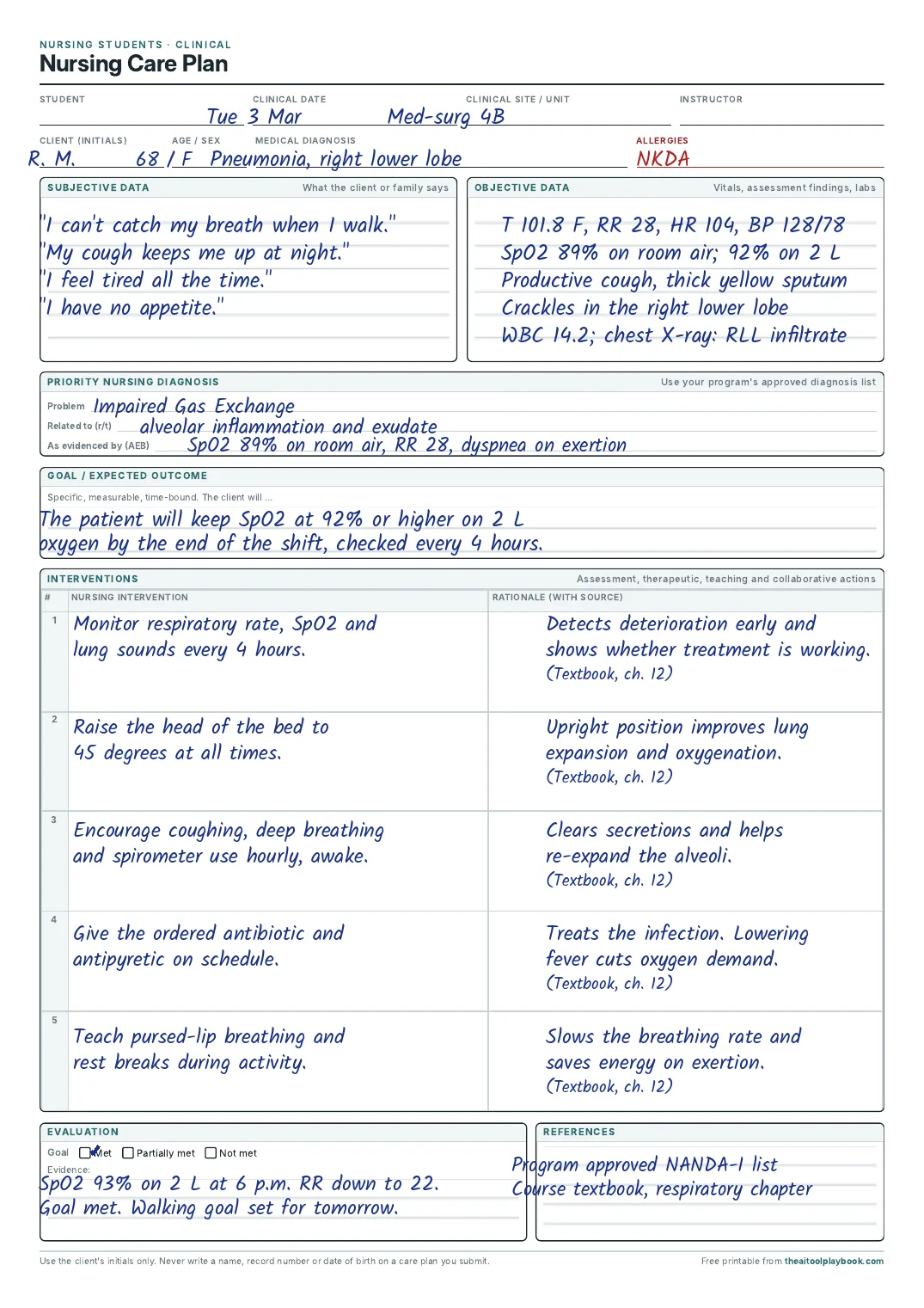
Meet Mrs. R. She is a fictional patient, invented for this example. She is 68 years old, and she was admitted yesterday with pneumonia in the right lower lobe of her lung. Here is her care plan, built step by step with the same template you downloaded above.
Her data
Subjective data, in her words: "I can't catch my breath when I walk." "My cough keeps me up at night." "I feel tired all the time." "I have no appetite."
Objective data: temperature 101.8 °F, respiratory rate 28, heart rate 104, blood pressure 128/78. Oxygen saturation 89 percent on room air, rising to 92 percent on 2 liters of oxygen. A productive cough bringing up thick yellow sputum. Crackles heard in the right lower lobe. White blood cell count 14.2, and a chest X-ray showing an infiltrate in the right lower lobe.
Clustering and the diagnosis
Her breathing findings cluster together: the low oxygen level, the fast respiratory rate, the breathlessness and the crackles all point to one problem with gas exchange. Her fever and raised white cell count form a second, smaller cluster around the infection itself. For the priority diagnosis, the breathing cluster wins, because of the ABC rule from step 3. Written in the three part format, her diagnosis is:
Impaired Gas Exchange related to alveolar inflammation and exudate, as evidenced by oxygen saturation of 89 percent on room air, respiratory rate of 28, and shortness of breath on exertion.
(On the NANDA-I list, the standard related factors printed for this diagnosis include ventilation-perfusion imbalance and alveolar-capillary membrane changes. If your program wants the list's exact wording, swap one of those in. The AEB part stays the same, because it comes from your patient, not the book.)
Her goal
The patient will keep oxygen saturation at 92 percent or higher on 2 liters of oxygen by the end of the shift, checked every four hours.
Her interventions
- Monitor respiratory rate, oxygen saturation and lung sounds every four hours. Detects deterioration early and shows whether treatment is working.
- Raise the head of the bed as ordered and as tolerated. An upright position improves lung expansion and oxygenation.
- Encourage coughing, deep breathing and incentive spirometer use every hour while awake. Clears secretions and helps re-expand the alveoli.
- Give the ordered antibiotic and antipyretic on schedule. Treats the infection, and lowering the fever cuts the body's oxygen demand.
- Teach pursed lip breathing and rest breaks during activity. Slows the breathing rate and saves energy on exertion.
Cite the source for each rationale by name and edition in the template's references box — for example, your course textbook — rather than a chapter number alone.
Her evaluation
By 6 p.m., her oxygen saturation is 93 percent on 2 liters, and her respiratory rate is down to 22. The goal asked for 92 percent or higher by the end of the shift, measured the same way, so the honest verdict is goal met. One problem sits outside that goal: she is still short of breath walking to the bathroom. It was never part of this goal, so it does not change the verdict. Instead it becomes the next goal, under her third diagnosis, Activity Intolerance, in tomorrow's plan. That is what evaluation is for. Every result feeds the next plan.
11. Mistakes instructors see again and again
Most lost points on care plans come from the same short list. Check your plan against each one before you hand it in.
A medical diagnosis in the diagnosis line
"Pneumonia" cannot be your nursing diagnosis, however sick the patient is. That word is the provider's diagnosis. Yours names the patient's response to the pneumonia: the gas exchange problem, the airway problem, the fever.
"Related to" written as a medical diagnosis
"Impaired Gas Exchange related to pneumonia" fails for the same reason. The related to part must name the mechanism a nurse can act on: inflammation, exudate, retained secretions, weakness, pain.
Goals that cannot be measured
"Breathe better" and "feel stronger" cannot be checked at the bedside, so the evaluation step becomes impossible. Every goal needs a number, a scale, a distance or a time.
Interventions with no rationale
A list of actions with no reasons reads like a task list, not clinical thinking. The rationale is where the learning shows. One honest sentence per intervention, with a source.
Data that does not support the diagnosis
If the AEB line lists findings your patient does not have, the whole plan falls apart, and instructors spot it fast. Every AEB item must exist in your own assessment data, word for word.
A diagnosis copied from a book, not from the patient
Textbook care plans are written for textbook patients, who all have textbook findings. Your patient is a specific person with specific numbers. A copied diagnosis rarely matches the data you actually collected.
Choosing a diagnosis nursing cannot treat
If no nursing action can change the problem, it does not belong in your plan, however serious it is. Pick the problem your care can move, and let the medical team carry theirs.
12. Using AI the honest way: 5 prompts that check your work
AI tools can make care plan practice faster, if you keep them in the right job. The honest job is reviewer, not author. An AI can check whether your data supports your diagnosis, test whether your goal is measurable, question you like an instructor, and quiz you on prioritization. What it must not do is write the plan for you. That work is the learning, and it is also what your program's AI policy almost certainly requires.
The rules: use invented or de-identified details only, never a real patient's information. Follow your program's AI policy. And remember that in clinical there is no chatbot. The thinking has to be yours, so practice it yours.
Prompt 1 · Check the diagnosis
Here is my assessment data and the nursing diagnosis I chose: [paste both]. Check whether my data actually supports this diagnosis. Tell me which findings support it, which do not, and what data I am still missing.
Prompt 2 · Test the goal
Here is the goal I wrote for my care plan: [paste goal]. Is it measurable? Check it against the SMART rules, and help me rewrite only the parts that fail.
Prompt 3 · Find the missing data
I am writing a care plan for this invented patient: [paste summary]. Ask me questions, one at a time, to find the assessment data I still need before I can choose a diagnosis. Do not suggest the diagnosis yourself.
Prompt 4 · Review the rationales
Here are my interventions and rationales: [paste]. Give me feedback on the rationales only. Point out any that do not explain why the action works. Do not rewrite them for me.
Prompt 5 · Prioritization quiz
Quiz me on prioritization. Take three nursing diagnoses for this invented patient: [paste summary]. Give them to me in random order, let me rank them, then check my ranking against the ABCs and Maslow's hierarchy and explain any I got wrong.
13. Frequently asked questions
How many nursing diagnoses should a care plan have?
Most student assignments ask for one priority diagnosis written in full, and some ask for three, ranked. Working nurses plan care for every active problem a patient has. Follow your assignment rubric. One diagnosis done in real depth teaches more than six shallow ones.
What is the format of a nursing diagnosis?
Three parts joined in one sentence: the problem, related to its cause, as evidenced by the signs and symptoms from your assessment. A risk diagnosis has two parts: the problem and its risk factors, because the problem has not happened yet.
What is the difference between a nursing diagnosis and a medical diagnosis?
A medical diagnosis names the disease, such as pneumonia, and is treated by the provider. A nursing diagnosis names the patient's response to that disease, such as Impaired Gas Exchange, and is treated by nursing interventions. The two sit side by side in the same patient's care.
Can I use ChatGPT to write my care plan?
You can use it to check your work, test your goals and quiz you, as the prompts above do. Having it write the plan for you breaks most program policies and skips the exact thinking the assignment exists to teach. If you use AI at all, use invented patient details, never real ones.
How do I write a rationale?
Write one or two sentences that explain the mechanism: how this action helps this problem. Back it with your course textbook or another source your program accepts, and list the source with your plan. If you cannot explain why an action works, choose a different action.
What is a risk nursing diagnosis?
It names a problem that has not happened yet but is likely without preventive action, such as Risk for Falls or Risk for Impaired Skin Integrity. It has no signs and symptoms, so instead of evidence, you list the risk factors that make the problem likely for this patient.
14. Final thoughts
Back to the student at 11 p.m. Same desk, same patient, same due date. The only difference is a method. Data first, sorted into clusters. A diagnosis in three parts, proven by that data. One measurable goal. A short list of actions, each with a reason. And at the end, an honest check of what actually changed. The blank page was never a knowledge problem. It was an order problem, and order can be learned.
Work one plan all the way through by hand, slowly, and the next one will take half the time.
Related guides
- 40 AI Prompts for Nursing Students (2026): prompts for study, care plans and clinical prep.
- Nursing Brain Sheets: How to Use One, Plus 8 Free Printable Templates: the shift sheets, including the care plan template used here.
- How to Use ChatGPT to Study for the NCLEX (2026): prioritization questions are care plan thinking in exam form.
- 25 AI Prompts for Nursing Instructors (2026): for the teachers grading the plans.
Care plans end in doses, and doses end in math. Keep the math sharp with our free Dosage Calculation Practice tool, with step-by-step answers and a timed exam mode.